


Building the first transcontinental railroad was one of the most monumental engineering feats of the 19th century. It required a visionary belief that it could be done, an act of Congress in the middle of a Civil War, the entrepreneurial drive of many businessmen, and the engineering and management skill to marshal the tens of thousands of workers needed to build an iron road across America’s frontier that would connect the eastern half of our country with the western half.
Congress provided powerful incentives to build it: for each mile completed, the company received grants of government land they could sell. Is it any wonder that the Central Pacific and Union Pacific, the two companies formed to build the railroad, competed to see who could build their section faster? If the CP built more miles than the UP then they would earn a bigger reward. No one should be surprised that this massive project was completed a year ahead of schedule and five years before Congress’s deadline.
The fierce competition between the two companies also incentivized them to ignore their racial and ethnic prejudices. Chinese immigrants made up about 90% of the CP’s workforce while the despised Irish Catholics made up the bulk of the UP’s workforce. Despite the prejudices against them, America’s ideals still represented a land of opportunity that attracted immigrants from around the world.
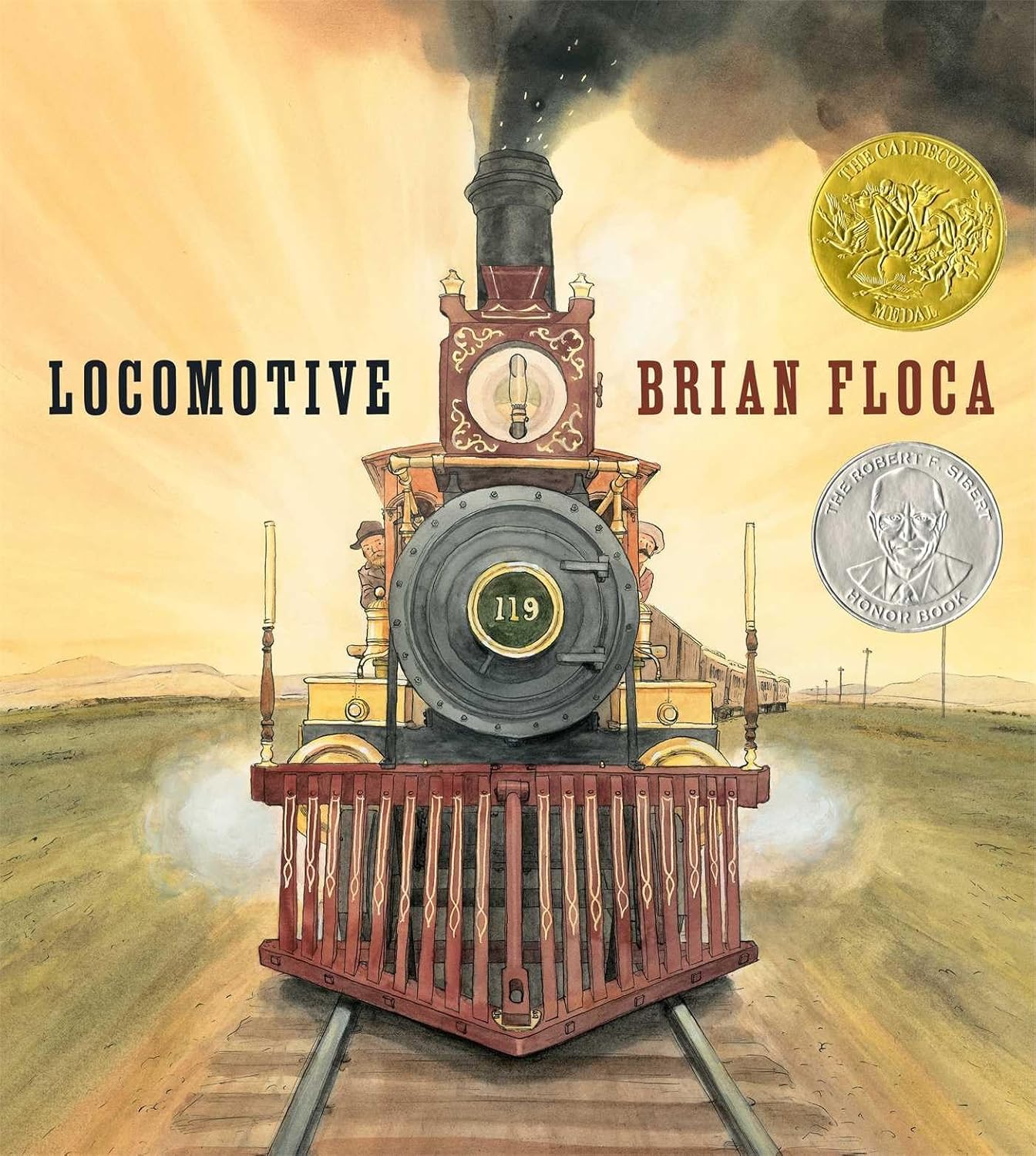
Title: Locomotive
Author: Brian Floca
Illustrator: Brian Floca
Year Published: 2013
Length: 64 pages
Below is one suggestion for your week with the book Locomotive. Please experiment with what works for your family! (Note: not all activities are included in the suggested sample week below).
toc: "American Heritage Songbook: _Canadian Railroad Trilogy_"
time: 5 minutes
freq: daily
There was a time in this fair land when the railroad did not run When the wild majestic mountains stood alone against the sun Long before the white man and long before the wheel When the green dark forest was too silent to be real
And when the young man’s fancy was turnin’ to the spring The railroad men grew restless for to hear the hammers ring Their minds were overflowing with the visions of their day And many a fortune won and lost and many a debt to pay
For they looked in the future and what did they see They saw an iron road runnin’ from the sea to the sea Bringin’ the goods to a young growin’ land All up through the seaports and into their hands
While this song is titled Canadian Railroad Trilogy, it paints a lyrical picture of the building of a transcontinental railroad that could equally apply to America. The first part describes the beauty of the land before industry and the railroad, “when the wild majestic mountains stood alone against the sun.” As Wikipedia notes, this section starts slow and “picks up speed like a locomotive building up a head of steam.” The second part segues to the vision for opening up the land via “an iron road runnin’ from the sea to the sea.” The final part pays tribute to the “navvies,” the laborers who did the back breaking work to build the railroad, “swingin’ our hammers in the bright blazing sun.”
There are a couple of good videos on YouTube that show photos of all three parts of the trilogy, including historical photos of the navvies building the railroad. The Canadian Broadcast Corporation commissioned Gordon Lightfoot to write the song to celebrate Canada’s centennial in 1967. It became one of his signature songs and is considered by some the best Canadian folk song ever written. This version, done as a tribute to Gordon Lightfoot, combines live performers with videos of the railroad being built in the background.
time: 30-60 minutes
prep: 15-20 minutes
supplies: cardboard, hot glue gun, straws, craft sticks, cotton balls, paper towel roll, egg carton, craft buttons, markers
Here is how this road was built, with a grunt and a heave and a swing, with the ring of shovels on stone, the ring of hammers on spikes: CLANK, CLANK, CLANK!
Coloring sheets: Here are a couple of different coloring sheets to get your young artists warmed up!
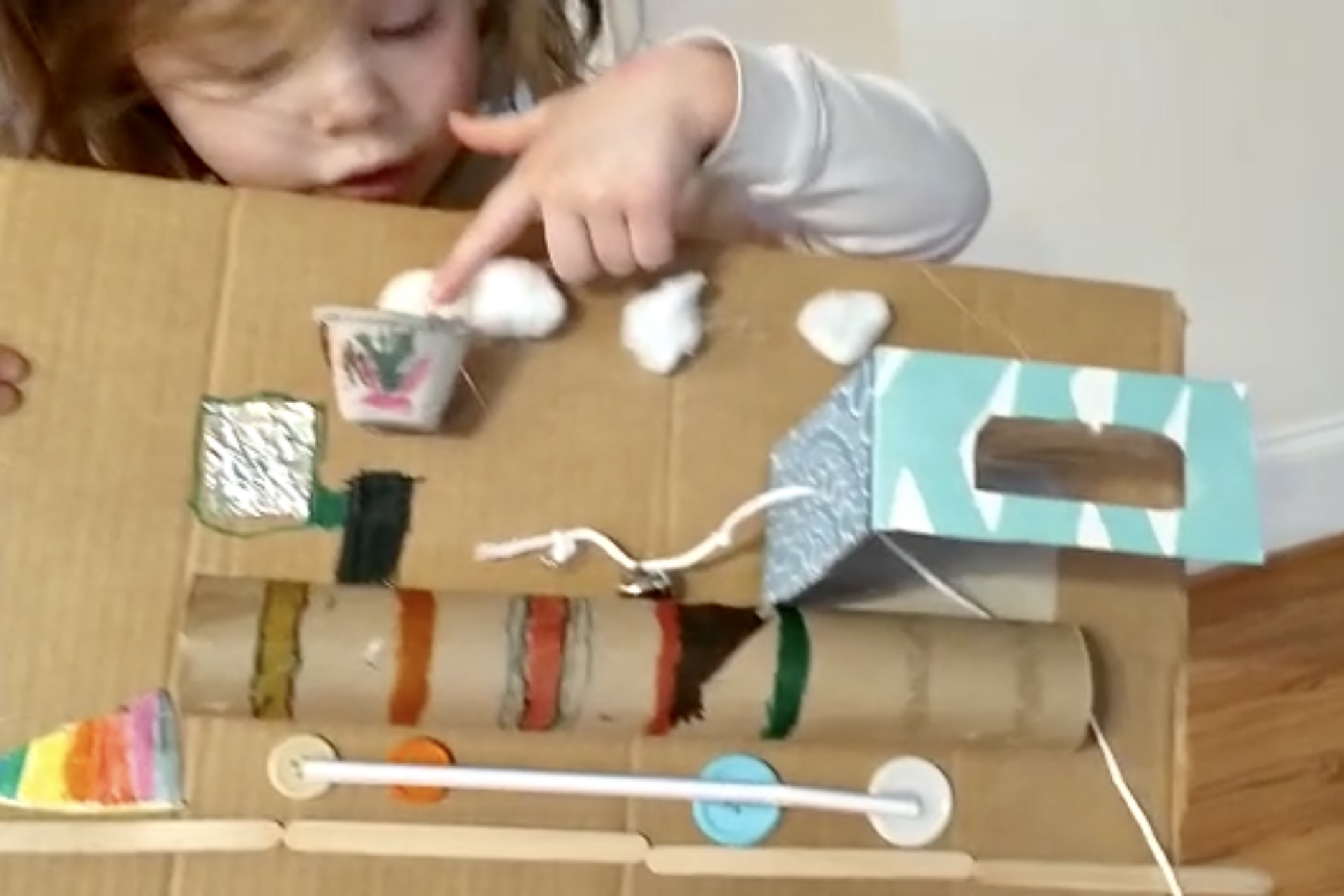
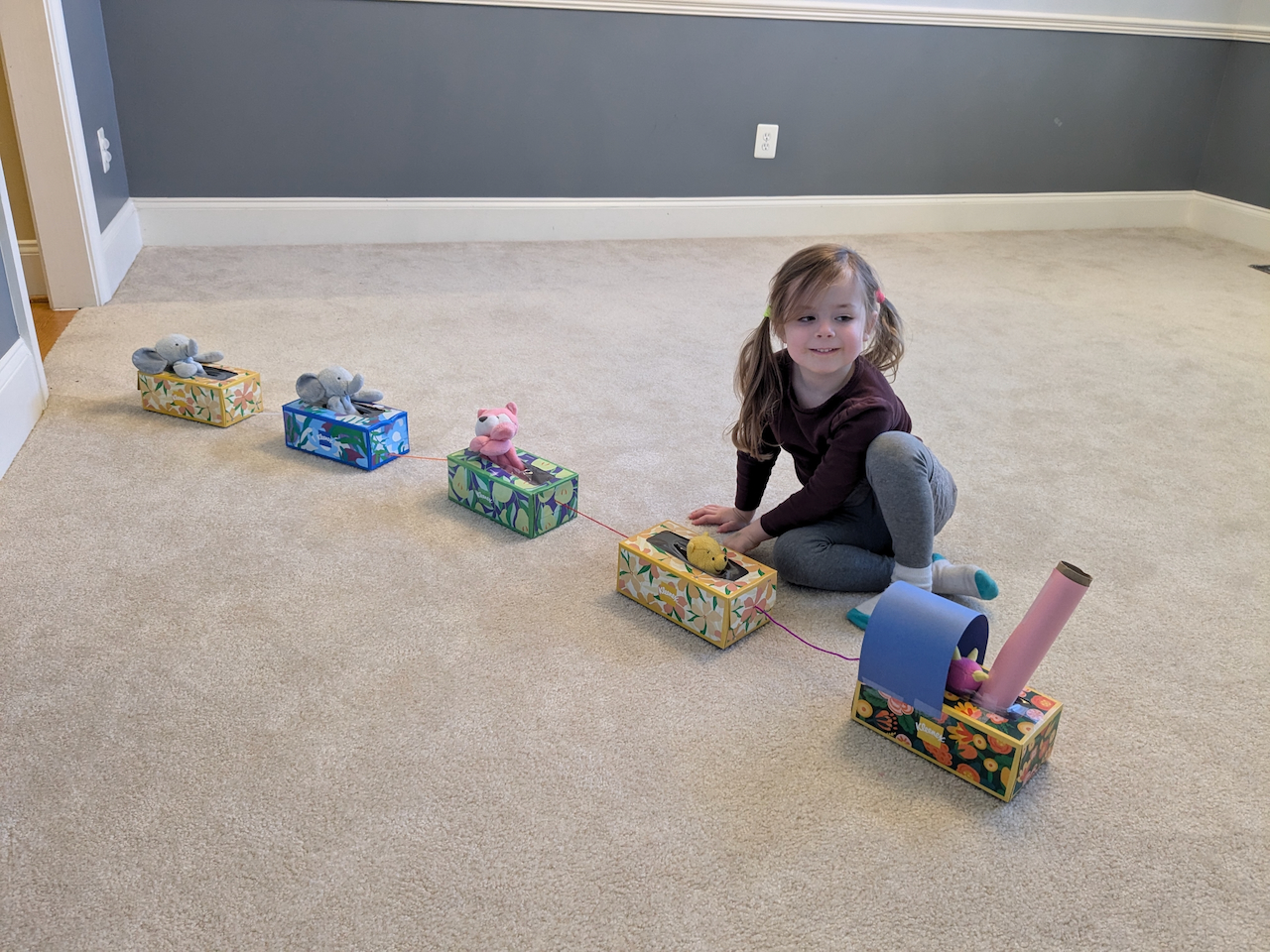
Note that there are many, many different potential train crafts. We have done both the shoe box train (Kleenex boxes work as well) which fits small stuffed animal passengers very well and also the egg carton train.
time: 20-30 minutes
prep: 5-10 minutes
supplies: tissue boxes, string, construction paper, paper towel roll, tape, scissors
Now the country’s far corners have been pulled together, thanks to the men who tend the engines, who mind the train and their passengers… thanks to the locomotive.
Select an empty tissue box for the engine. Stick the empty paper towel roll in the slot for the tissue and push it all the way to one end (color it or cover with colored paper first if you wish). Tape (or glue) in place. Take a rectangle of construction paper and bend it into an arch over the back half of the engine tissue box. Tape into place.
Use scissors to punch a hole in the back-side of the engine. Punch holes in opposite ends (the short sides which are farthest apart) of each of the other empty tissue boxes except the last one (caboose) which will only have one hole.
Cut pieces of twine about 10-12 inches to put between each of the “cars” of the train. Thread the twine through the holes between two “cars” (tissue boxes) knot the ends and tape in place so the twine doesn’t slip out. (Optionally cut one large piece and thread all the cars through it knotting each end (in the engine and caboose) and taping into place).
Optionally decorate the sides of the train cars with construction paper, markers, etc.
Stick small stuffed animals in the tissue slots of the boxes and let them travel across the country (or at least across your house)!
time: 10 minutes
supplies: U.S. puzzle
Thus rivals as well as partners in their great enterprise, the Central Pacific and Union Pacific send their work crews racing together from West and East.
The three greatest mountain ranges in the United States are the Appalachians in the east and the Rocky Mountains and Sierra Nevada in the west. All three ranges run north and south, dividing the east from the west. The Appalachians are significantly smaller than the other two – the highest peak is 6,604 feet.
The highest peaks in the Rockies and the Sierra Nevada are more than twice that high; Mount Whitney, in the Sierra Nevada range, is the highest peak in the continental United States at 14,505 feet. The transcontinental railroad had to cross both these mountain ranges. The Union Pacific, coming from the east, had to cross the Rockies and the Central Pacific, coming from the west, had to cross the Sierra Nevada.
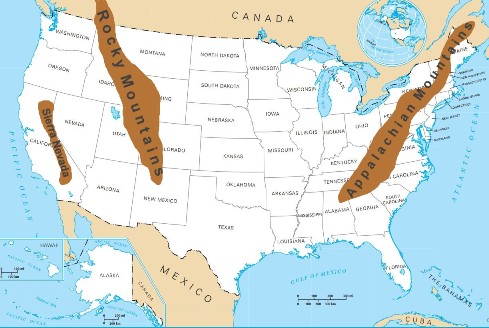
Ask your kids to look at the map on the inside cover of Locomotive. Which railroad, the Union Pacific or the Central Pacific, built the most miles of railroad track? Why do you think one railroad built significantly more miles of track than the other?
There is a narrow cross-sectional map underneath the larger map on the inside cover. This map illustrates the different challenges confronting the two railroad companies. The Union Pacific, starting from Omaha, Nebraska, had a nice gradual climb to the Rockies. The Central Pacific, starting from Sacramento, California, faced the enormously steep Sierra Nevada. They had to dynamite their way through granite to build 15 tunnels.
To illustrate how the transcontinental railroad connected the east and the west, get a jigsaw puzzle of the United States and do the following:
time: 5 minutes
freq: daily
May God continue the unity of this Country as this Railroad unites the two great Oceans of this world.
The sentence above was inscribed on the Golden Spike used to commemorate the completion of the transcontinental railroad at Promontory Summit, Utah on May 10, 1869. East met West and a journey from New York to San Francisco that used to take six months could now be done in about a week. The inscription is also a reminder of America’s E Pluribus Unum motto: “Out of many, one.”
While the Golden Spike is the most famous, there were actually three other ceremonial spikes driven that day. All four were donated to mark the historic occasion of connecting the country with an iron road – an “engineering marvel” that papers called the “eighth wonder of the world” at the time. The San Francisco News Letter donated a second, lower-quality golden spike with the inscription: “With this spike the San Francisco News Letter offers its homage to the great work which has joined the Atlantic and Pacific Oceans.” The state of Nevada donated a silver spike without an inscription. And the Territory of Arizona (not yet a state) donated a spike made of silver and topped with gold inscribed, “Arizona presents her offering to the enterprise that has banded a continent and dictated a pathway to commerce.”
When the Golden Spike was hammered in, the word DONE was sent by telegraph across the country. Fireworks exploded, cannons roared, champagne glasses were raised, and the Liberty Bell rang out to mark the occasion.
To remind your kids of this momentous occasion, ask them to memorize the inscription on the Golden Spike.
time: 20-30 minutes
prep: 10-15 minutes
And if you’re bored, if you’re hungry, there is the “butch” – a boy who walks the aisle and sells books, maps, magazines, yesterday’s paper, fruits and candies, soap and towels, coffee, tea, sugar, hash, beans, bacon, and all the cigars you can smoke.
The ancestors of today’s strawberry were a tiny but flavorful berry native to Virginia and a large but bland berry native to Chile. They were accidentally cross-bred in the 18th century but a version that would grow in American soil wasn’t developed until the 1840s. And then “Strawberry Fever” swept America. From 1858 to 1870, a 12-year period that saw the first transcontinental railroad built, strawberries commanded premium prices. While we don’t know if the “butch” sold strawberries to railroad passengers, he might have.
Strawberry Shortcake became an iconic American dessert. The sweeter variety uses angel food cake as the shortcake and was more prevalent in the northern states. The southern states favored a buttermilk biscuit for the shortcake. While not raised in the south, our traditional family recipe for Strawberry Shortcake is based on the buttermilk biscuit.
time: 15-20 minutes
prep: 30-60 minutes
supplies: tea kettle (or covered pot)
The sounds of the engine surround him: the rhythm of pistons, pounding like hammers, the drivers drumming the rails, the smoke and the steam rushing up through the stack: CHUG-CHUG CHUG-CHUG CHUG-CHUG!
Brian Floca does not waste any space in Locomotive. Inside the front cover, he illustrates the geography, map, and political history of the first transcontinental railroad. Inside the back cover, he illustrates the science and engineering that power the locomotives of that era.
The upper left-hand corner of the back cover illustrates a simple experiment you can do with your kid(s) to show them the basic principle of steam power. Water, when heated, turns to steam which takes much more space than the liquid water. If the expansion into steam is confined to a small space it exerts a force. That force can be used to lift the lid on a covered pot, make a tea kettle whistle, or even power a locomotive that pulls an entire train.
toc: "Re-enactment: Build Your Own Transcontinental Railroad"
time: 20-60 minutes
prep: 20-30 minutes
supplies: toy railroad tracks and locomotives (Brio, Hape, etc.)
Here is a road made for crossing the country, A new road of rails made for people to ride.
This activity can work with as little as two people. However, it works best with more so you can have two teams competing against each other (and the clock) to build your own transcontinental railroad. Think about inviting extended family, friends, or other homeschooling families to join you in this friendly competition.
To start, you will need to construct your own continent that needs crossing. It could be two rooms of your home that need to be connected, with one room labeled EAST and the other WEST (or Omaha and Sacramento). Two sides of a room could also work. Or perhaps somewhere outside. However you decide, there will need to be “mountain ranges” for each side to overcome as they build their railroad toward a designated meeting place. Be creative with placing the “mountain range” obstacles. The teams will have the most fun figuring out how to build their railroad around, over, and through the obstacles.
The two teams, Central Pacific (CP) and Union Pacific (UP), will need to be supplied with generous portions of railroad track (we used Brio). The goal for each team is to build their railroad as quickly as possible, overcoming any obstacles along the way. Once the road is laid down, a locomotive and tender must traverse it and meet the other team at “Promontory Summit” for the Golden Spike ceremony. If you have battery-powered locomotives it can be fun to see if they can successfully make the journey to the halfway point.
There are multiple competitive opportunities you can incorporate – which team builds the most track, which team arrives at “Promontory Summit” first. To simulate the incentives that motivated the CP and UP you can reward the teams with candy or snacks for every piece of track laid (creating a perverse incentive to use short pieces of track, similar to the perverse incentives the government used to make the CP and UP build longer tracks and routes rather than shorter, more efficient routes).
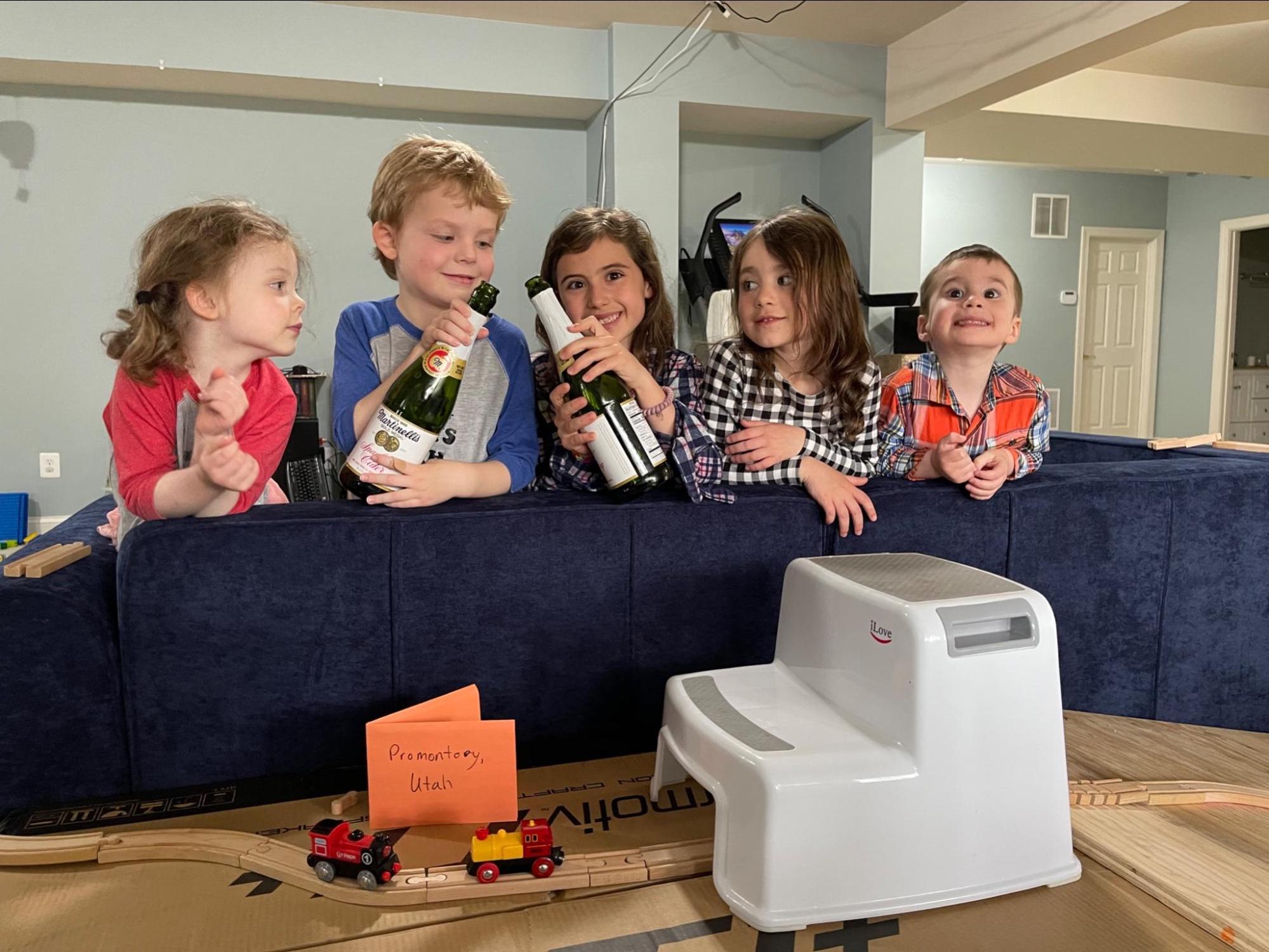
The “Champagne” Shot.
time: 15 minutes
But Crocker and his crew had learned from their hardships. Now they were an efficient force. As the transcontinental railroad was nearing completion, his army stood ready for its final battle, Ten Mile Day.
Ten Mile Day, written and illustrated by Mary Ann Fraser, is an excellent supplemental reading to Locomotive. Ten Mile Day focuses on how the railroad was built with particular emphasis on the Central Pacific’s Chinese immigrant workforce and how they overcame not only the prejudices against them but also the dangerous challenges they faced. Fraser engages the reader by framing her story around the ten-mile-day bet between Charles Crocker of the Central Pacific and Thomas Durant of the Union Pacific.
Ten Mile Day has much more text than Locomotive so we suggest reading it once during the week either in addition to Locomotive or perhaps instead of it.
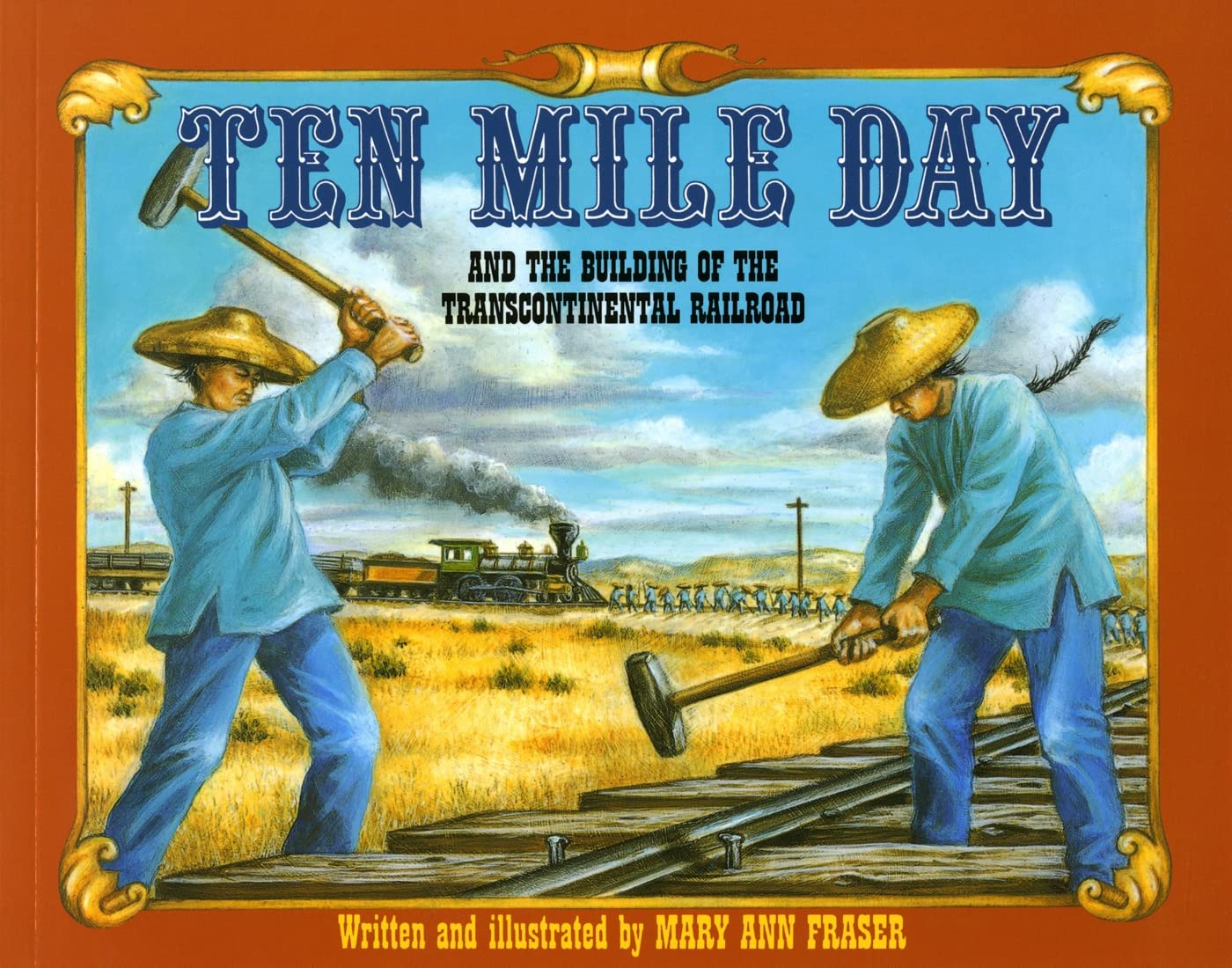
Title: Ten Mile Day: And the Building of the Transcontinental Railroad
Author and Illustrator: Mary Ann Fraser
Year Published: 1996
Length: 40 pages
time: 10 minutes
There is neither Jew nor Greek, slave nor free, male nor female, for you are all one in Christ Jesus. (Galatians 3:28)
The scripture above is echoed in 1 Corinthians 12:13. The words on the Golden Spike echo these words from the Bible, emphasizing unity. And it seems a fitting verse considering events surrounding the building of the transcontinental railroad.
Abraham Lincoln signed the legislation authorizing the transcontinental railroad in 1862, the middle of our great Civil War that would lead to the abolition of slavery in America. But slaves weren’t the only people discriminated against. The men who built the first transcontinental railroad generally came from ethnic immigrants, Irish for the Union Pacific, and Chinese for the Central Pacific, denied opportunities available to other Americans.
Despite the prejudices against them, these men demonstrated the “Full Steam Ahead” spirit of Americans, completing the first transcontinental railroad a year ahead of schedule – with a final, recordbreaking sprint of ten miles in a single day by the Central Pacific Chinese teams. As part of the Golden Spike ceremony, eight Chinese in new blue jackets laid the final pair of rails.
It took many more decades for the contributions these immigrants made to be recognized as part of the promise to all Americans. Consider having your kids memorize the scripture above as a reminder of the unity we should all feel as Americans, no matter where we originated from. E Pluribus Unum!
time: 10 minutes
If the rails are slick, if the wheels won’t catch, the engineers can pull a handle to drop some sand down a tube, onto the tracks. The wheels hit the grit, the traction does the trick…
This module’s vocabulary words are evenly divided between railroad terms (tender, throttle, trestles, traction), and words describing the country and towns the first transcontinental railroad traveled through (frontier, rugged, rowdy, bleak).
time: 10 minutes
… through the Great Basin, a bleak and silent land– silent except for the HUFF and the BANG and the HISS of the engine, the CLICK and the CLACK of the cars.
The long word onomatopoeia means to form a word from the sound it makes. Brian Floca, the author, uses onomatopoeia extensively throughout the story as he describes the sounds of the locomotive. In the sentence above, he uses it five times. In other places, his artwork emphasizes it even more: the “rickety, rickety, rickety” of the trestles, the “ka-boom” of a locomotive exploding.
Ask your kids to look for other examples of sounds turned into words throughout the story. They are usually indicated by capital letters and artfully drawn letters. But occasionally, the author uses the big letters to emphasize action, so the kids will have to pay attention!
time: 10 minutes
He is the master of his machine, he knows her moods and tempers, where to set her bars and levers, when to slow down and when to speed up, when to run her wide open – FULL STEAM AHEAD!
Nowadays the expression, “Full steam ahead!” means to give a maximum effort with all the energy and enthusiasm you can muster. What a great description of the entrepreneurial engine that drives American innovation!
The expression originates from the early days of the steam engines on boats and locomotives. Locomotive engineers and ship captains would order “Full steam ahead!” when they wanted maximum power from their steam engines.
Think of a time when you were “Full steam ahead!” and share the story with your kids. Ask them about the last time they went “Full steam ahead!”