


After our flag, the Statue of Liberty is the second most evocative symbol of what the United States of America stands for. Our history as a nation is all about the struggle to provide increasing liberty to more of our citizens.
From our earliest beginnings we saw ourselves as a “shining city on a hill,” a beacon of liberty for other nations to emulate. The Statue of Liberty Enlightening the World holding her torch aloft is the physical manifestation of that ideal.
For many years Liberty and her torch served as the focal point for immigrants seeking their fortune in the new world, coming to America for a better life for themselves and their families. They left the oppressions of their old life behind for the freedom that America offered.
The Statue of Liberty was a gift from the French people to the American people. The French people paid for the statue itself while the Americans paid for the pedestal the statue stood on. Over 120,000 people in the United States donated funds for the pedestal with 80% of them donating less than a dollar—a great example of how widespread American generosity is and our devotion to Liberty.
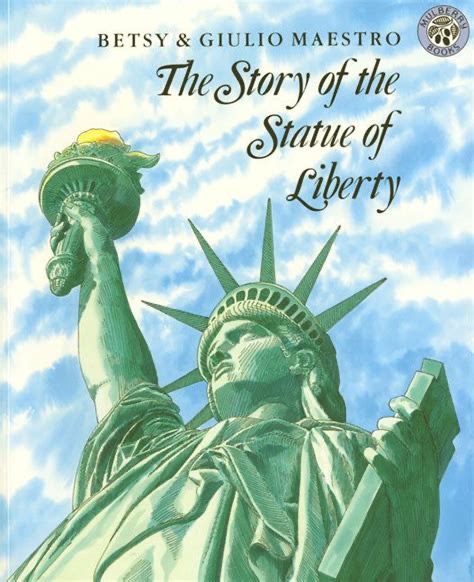
Title: The Story of the Statue of Liberty
Author: Betsy Maestro
Illustrator: Giulio Maestro
Year Published: 1989
Length: 48 pages
Below is one suggestion for your week with the book The Story of the Statue of Liberty. Please experiment with what works for your family! (Note: not all activities are included in the suggested sample week below).
time: 5 minutes
freq: daily
Samuel Francis Smith wrote the lyrics to America when he was a seminary student in 1831. He used the melody from the British national anthem, God Save the Queen. The song was a strong contender for the national anthem of the United States of America but, in 1931, Congress chose the Star-Spangled Banner instead.
The song’s opening lyrics celebrate America as the “sweet land of liberty” with the first verse ending with the uplifting call to “let freedom ring!”
My country ‘tis of thee Sweet land of liberty Of thee I sing Land where my fathers died; Land of the pilgrims’ pride From ev’ry mountainside Let Freedom Ring!
The last verse evokes America’s deep religious culture as well as Smith’s theological background as it calls on God’s protection and blessing:
Our fathers’ God to thee, Author of Liberty, To Thee we sing. Long may our land be bright, With freedom’s Holy light, Protect us by Thy might, Great God, our King.
The Mormon Tabernacle Choir sings it with lyrics set against wonderful images of America here. Kelly Clarkson’s 2013 version, with lyrics and images, is here. Marian Anderson, a famous contralto, was denied permission to sing in front of an integrated audience by the Daughters of the American Revolution. Instead, Eleanor Roosevelt arranged for her to sing America to a crowd of 75,000 in front of the Lincoln Memorial on Easter Sunday, 1939. Millions more heard her perform live on the radio. Finally, an elegant version of the first verse was arranged by Michael Hedges and sung by David Crosby & Graham Nash immediately after 9/11.
time: 10-20 minutes
supplies: Crayons, Pencil, Coins
The Statue of Liberty stands on an island in New York Harbor. She is a beautiful sight to all who pass by her.
As usual, our kids loved coloring and connect-the-dots sheets featuring the Statue of Liberty.
time: 15 minutes
supplies: U.S. Puzzle, Globe
Bartholdi had created many other statues and monuments, but this one was to be very special. It was to be a present from the people of France to the people of America, as a remembrance of the old friendship between the two countries.
When the Statue of Liberty was unveiled in New York’s harbor in 1886, the United States had grown to 38 states. Colorado was the most recent, joining the union in 1876. The 12 twelve territories yet to become states were: North Dakota (1889), South Dakota (1889), Montana (1889), Washington (1889), Idaho (1890), Wyoming (1890), Utah (1896), Oklahoma (1907), New Mexico (1912), Arizona (1912), Alaska (1959), Hawaii (1959).
Take your jigsaw puzzle map of the United States and remove all the states that have not yet joined the union. Alternatively, take a map of the United States and color in the states that are part of the Union. Label the sheet “1886.”
The country of France played a crucial role in America’s War of Independence from Great Britain. At that time, France was also at war with Great Britain so it made strategic sense for them to ally with America. However, the gift of the Statue of Liberty from the people of France to the people of America had no such geopolitical strategic goals. In fact, the project was initiated by private individuals, (Frederic Bartholdi, Edouard de Laboulaye), just to express their love of liberty and the friendship between two peoples in honor of America’s centennial.
Locate France on a globe and show your child(ren) how the Statue of Liberty had to be transported across the Atlantic Ocean in order to reach its destination in New York.
time: 5-10 minutes
freq: daily
Not like the brazen giant of Greek fame, With conquering limbs astride from land to land; Here at our sea-washed, sunset gates shall stand A mighty woman with a torch, whose flame Is the imprisoned lightning, and her name Mother of Exiles. From her beacon-hand Glows world-wide welcome; her mild eyes command The air-bridged harbor that twin cities frame.
“Keep ancient lands, your storied pomp!” cries she With silent lips. “Give me your tired, your poor, Your huddled masses yearning to breathe free, The wretched refuse of your teeming shore. Send these, the homeless, tempest-tost to me, I lift my lamp beside the golden door!”
As part of the fundraising effort to erect the pedestal for The Statue of Liberty Enlightening the World, Emma Lazurus wrote a sonnet called The New Colossus. The poem was published in both Joseph Pulitzer’s New York World and the New York Times, initially enjoying wide popularity. Lazarus died the year after the Statue of Liberty was erected and the poem faded from popular memory until a friend of hers rescued it from obscurity in 1901. The poem is now inscribed on a plaque mounted on the pedestal.
Lazarus’s poem celebrates Liberty as the “Mother of Exiles,” a symbol of hope for immigrants seeking a new opportunity. The most famous line has Liberty saying, “Give me your tired, your poor, your huddled masses yearning to breathe free.”
Read the poem to your child(ren). Point out to them the rhyme scheme and how it starts out “ABBA” but changes at the end to “CDCDCD” when Liberty starts speaking.
Ask them to memorize the famous line from the poem, in bold above. Practice each day after reading the story to them.
time: TODO
At last, in 1886, Liberty was standing where she belonged. A wonderful celebration was held.
The Statue of Liberty is one of the preeminent symbols of the United States of America. Even though it originated in France, we think of it “as American as apple pie.” Interestingly enough, apple pie also has its origins in old Europe. In fact, apple trees are not native to America and had to be imported from Europe.
So, how did apple pie come to symbolize something that was typically American or patriotic? It started in 1796 when American Cookery, the very first American cookbook, was published. It contained two recipes for apple pies. Apple pie became a dish with widespread popularity throughout America. The expression “as American as apple pie” was first used in the 1800s but became much more widely used after World War II, when American soldiers, when asked what they were fighting for, answered “for Mom and apple pie.”
Apropos the European origin of the apple pie and America’s propensity for borrowing many of our cultural elements, the recipe below comes from the picture book How to Make an Apple Pie and See the World.
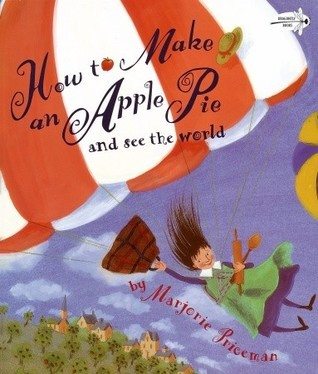
You can make your own pie crust (yes, there is a recipe in the story for pie crust also). But the simpler method we used was to purchase a two-pack of frozen pie crusts.
time: 20 minutes
prep: 10 minutes
supplies: Pennies, Bowl, Vinegar, Salt, Towel
Then, a skin of gleaming copper was put onto the skeleton and held in place by iron straps. As the huge statue grew, all of Paris watched with great fascination.
Both The Story of the Statue of Liberty and Her Right Foot describe how the Statue of Liberty is made from copper and started out brown, gradually changing to the bluish-green color we know today after decades of oxidation. Her copper covering is approximately the width of two pennies, which leads to our science demonstration. We will speed up the process of oxidation and turn a brown penny bluishgreen in just a couple of hours.
For this demonstration you will need:
As an additional control, we included nickels with the pennies. We thought we would demonstrate the difference between copper and nickel. Our expectation was that the nickel would not be oxidized. To our surprise, we learned that nickels are actually made up of 75% copper. It oxidized and turned bluish-green just as readily as the pennies. Ah, the serendipity of science :-)
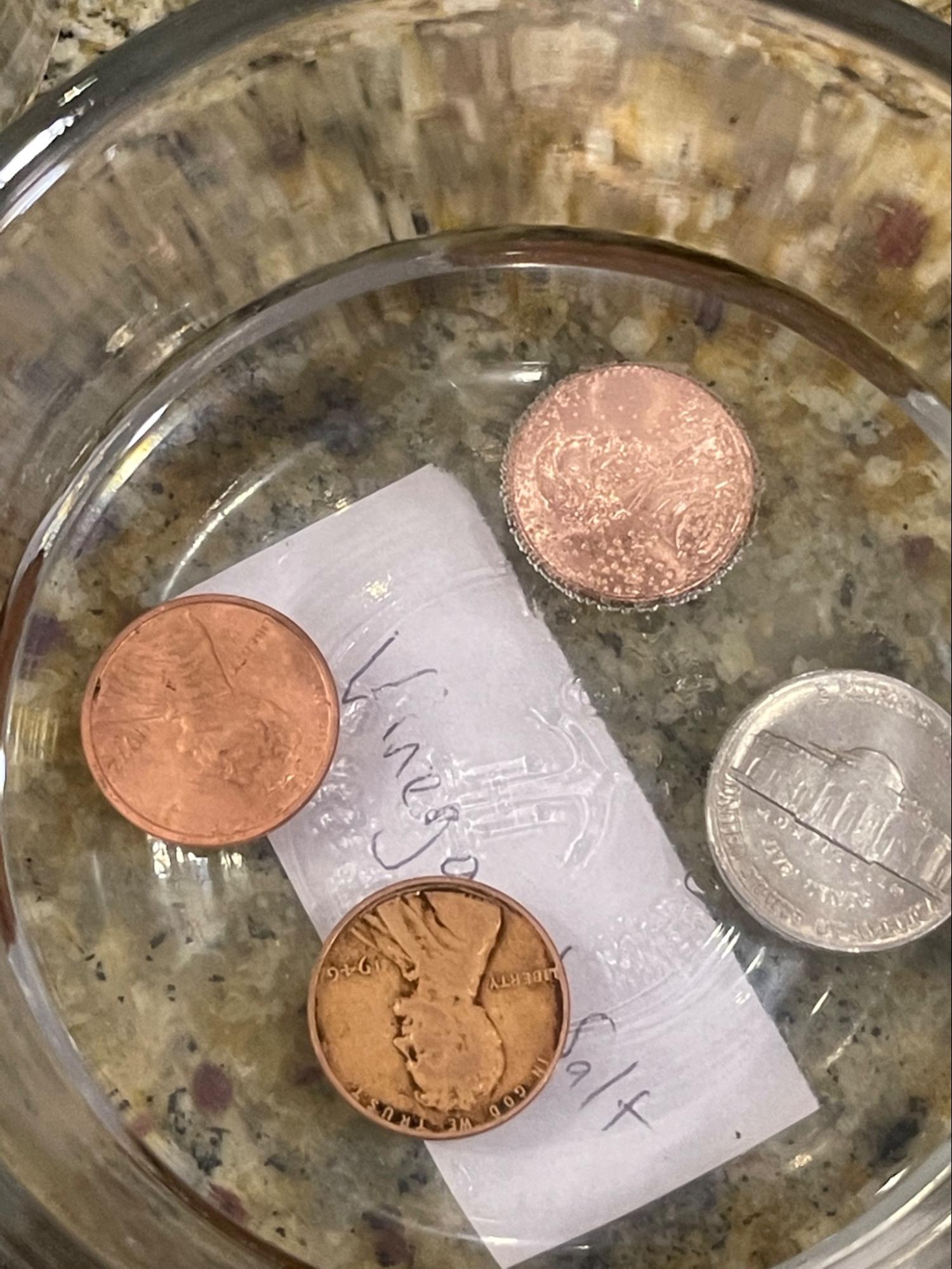
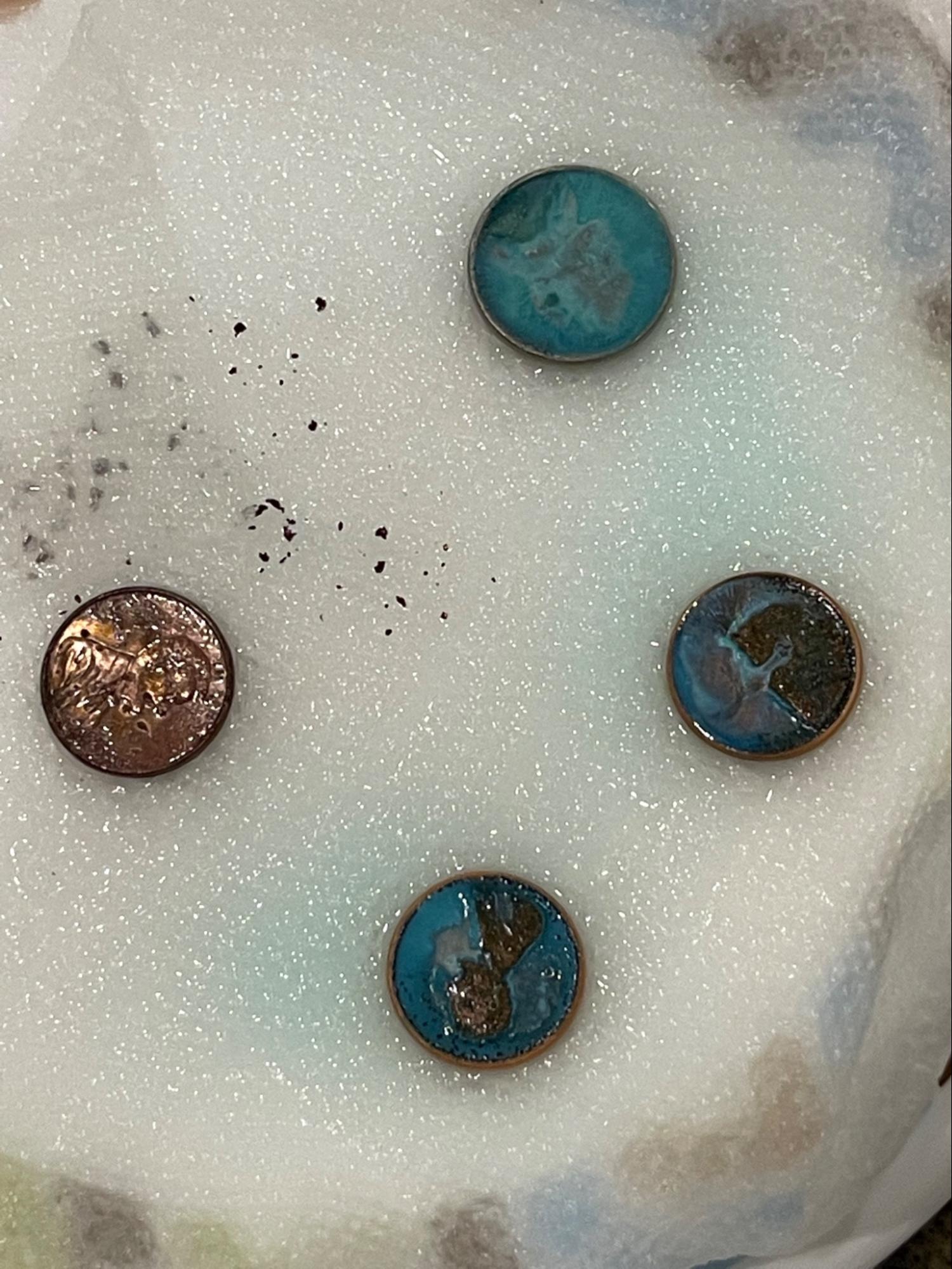
The nickel is in the 12 o’clock position.
time: 10-15 minutes
toc: "Science: Take a Virtual Tour"
First, a huge skeleton was constructed from strong steel.
The Statue of Liberty is an engineering marvel. Alexandre Gustave Eiffel, the man who later built the Eiffel Tour, developed her internal skeleton which supports the weight of her tons of copper sheathing. You can see some of this in person if you can visit the Statue of Liberty in New York. But much of the internal structure is not open to the public. The National Park Service created a fascinating virtual tour that shows many of the internals of the Statue of Liberty (as well as the externals). You start at the top, Liberty’s Torch!
time: 20 minutes
prep: 30 minutes
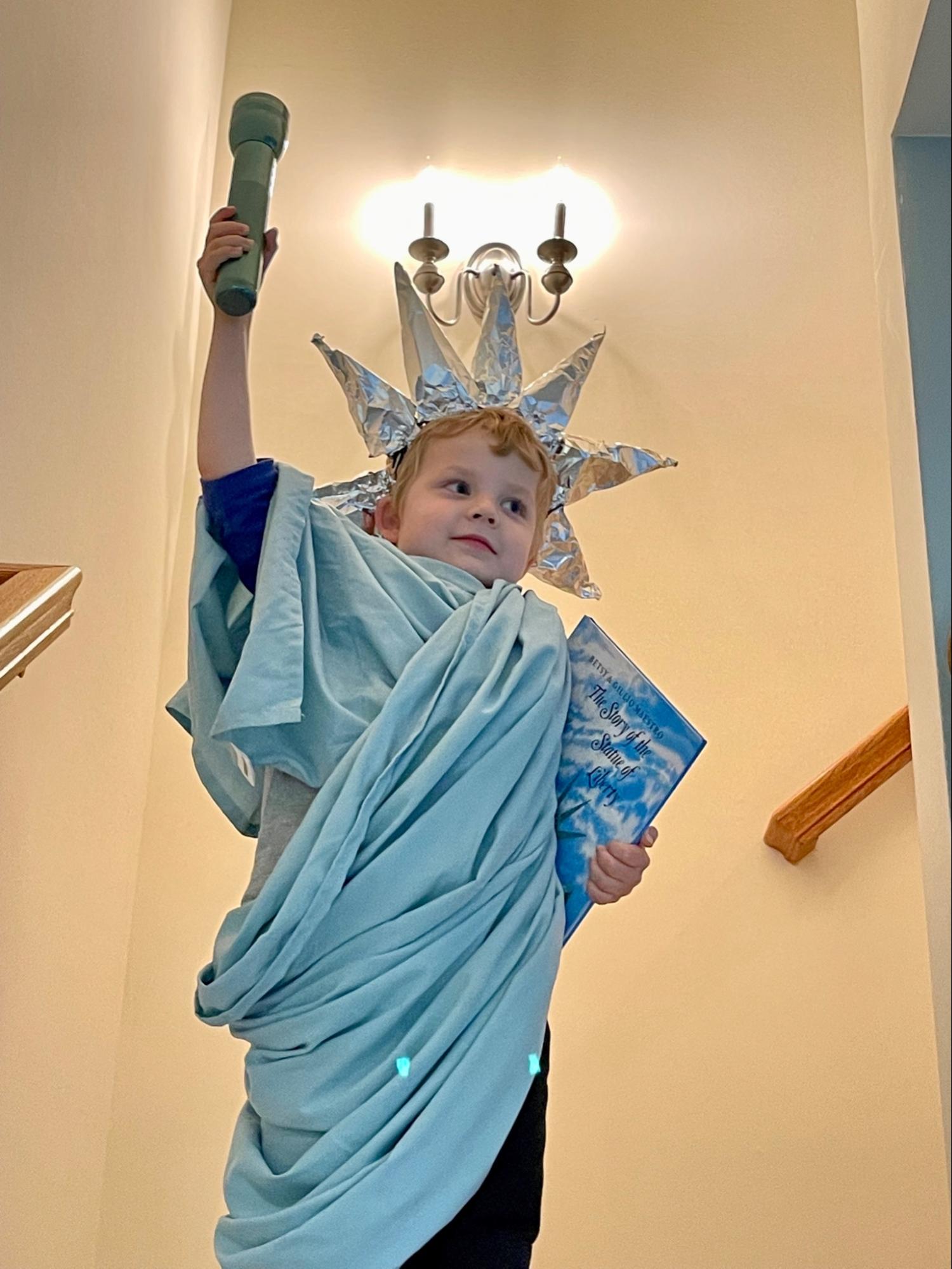
supplies: Sheet, Flashlight, Headband, Foil
Many people worked together in a large workshop. Some worked on Liberty’s head and crown. Others worked on her right hand which would hold the torch.
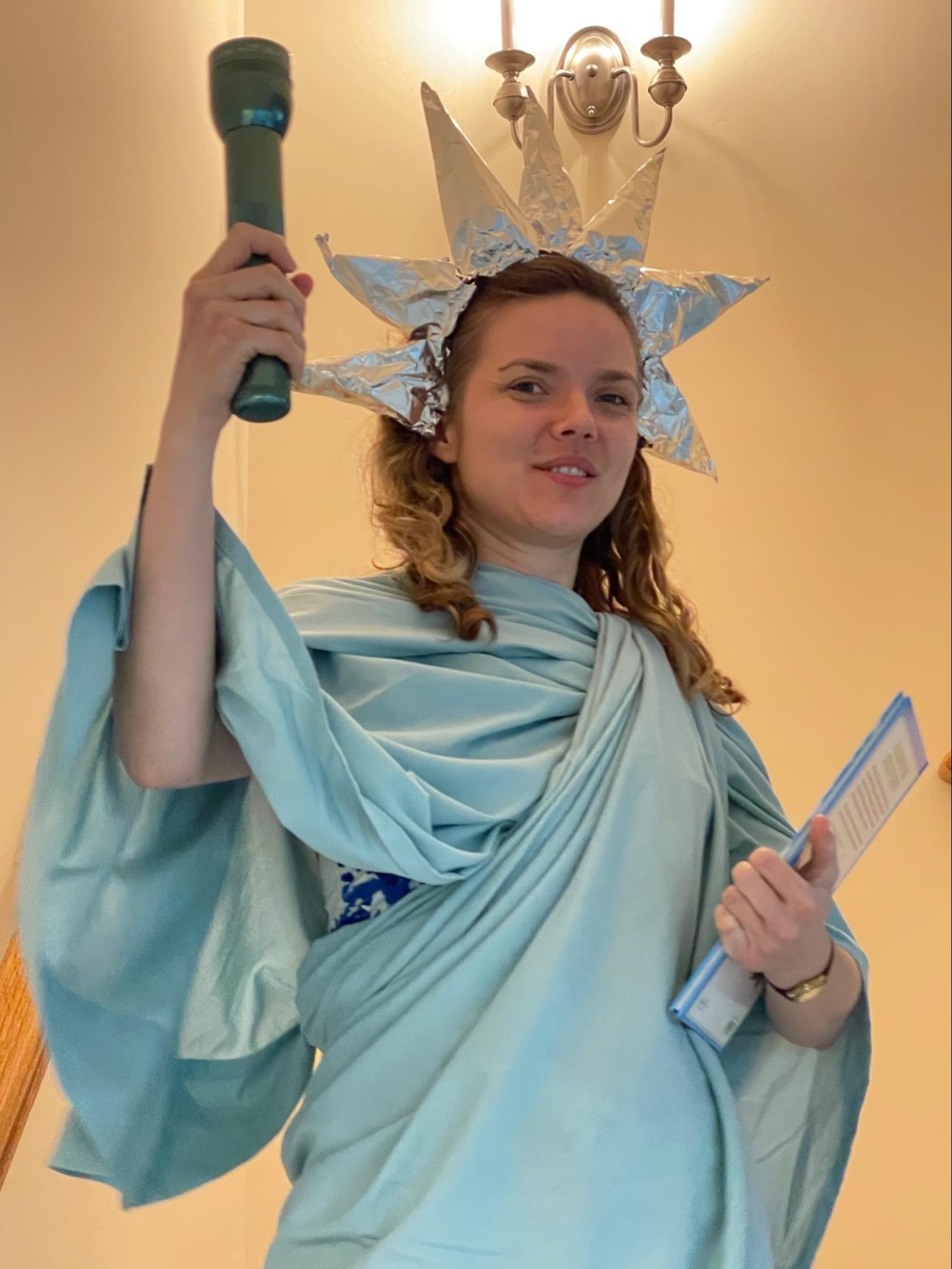
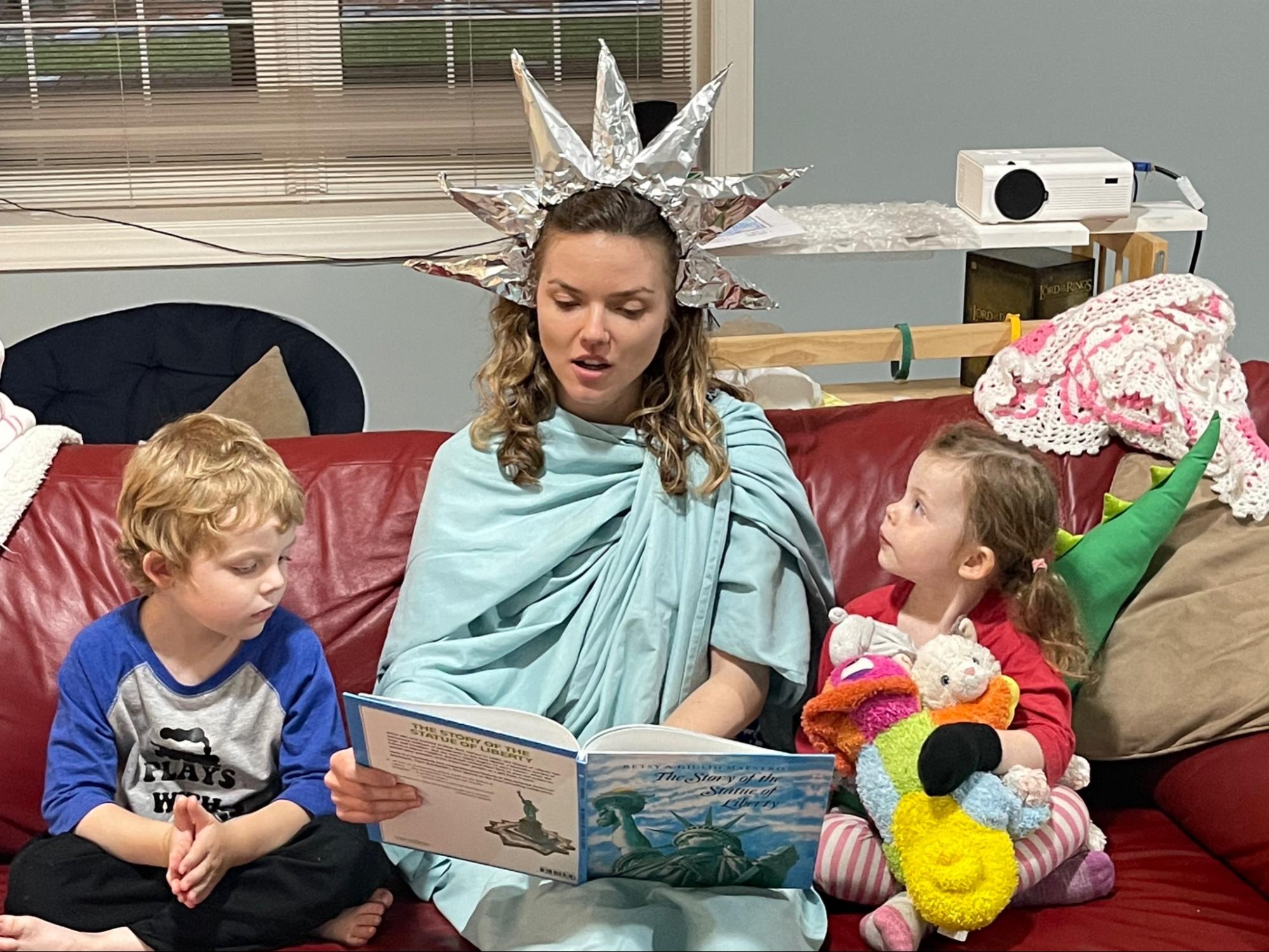
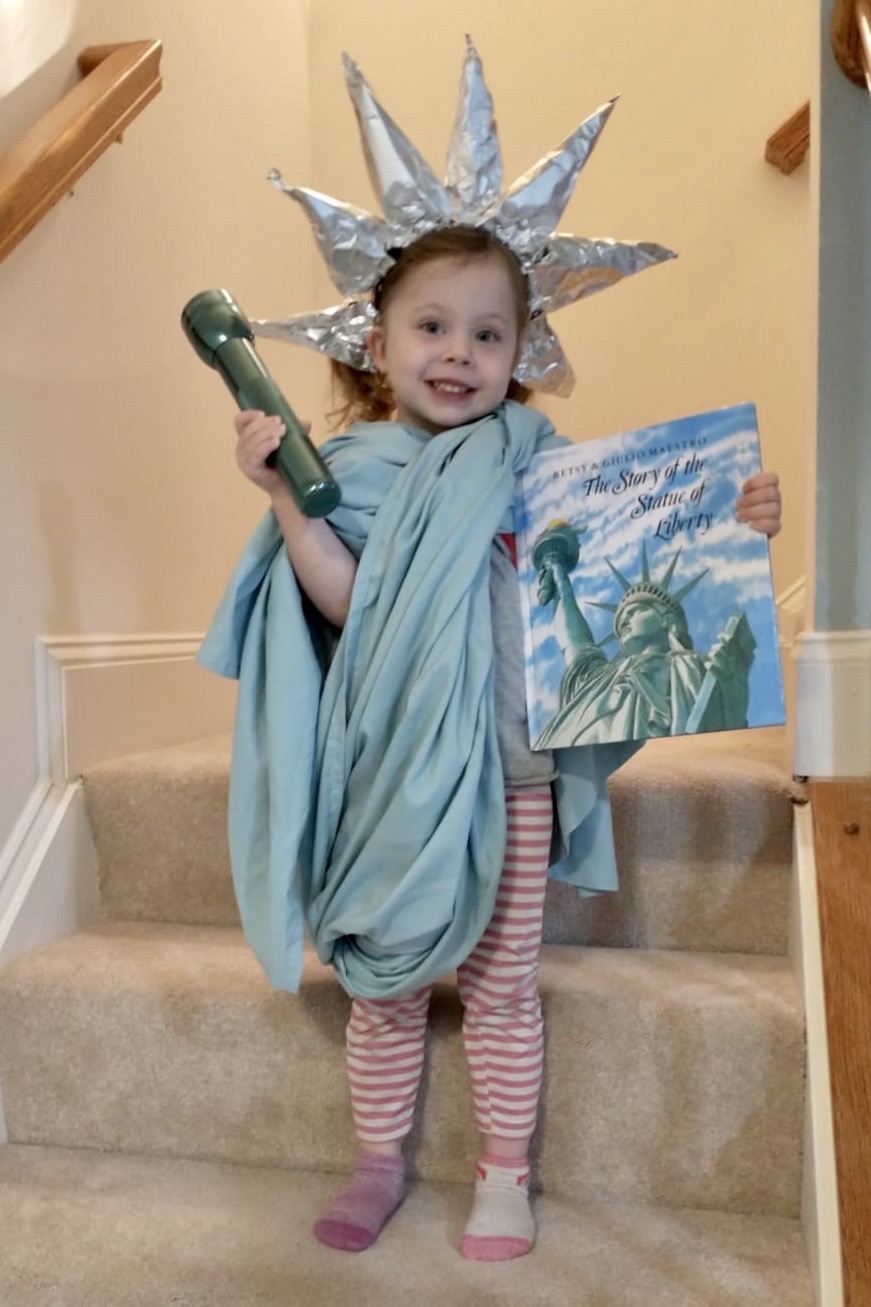
This activity was fairly spontaneous and turned into a huge hit with the kids. One of their aunts suggested including more dress-up and costumes as part of the activities. As we were just about to launch this module, we challenged her to put together a Statue of Liberty outfit and do the first reading in it. As you can see below, she rose to the challenge with the help of a sheet, a flashlight, a book and a handmade crown (headband and foil). (Yes, to our surprise, we actually owned a bluish-green sheet that worked perfectly; however, a brown, pre-oxidation sheet, would have also worked nicely :-) The kids loved it and afterwards both wanted to dress up as Liberty (tip: you might want to remove the batteries for three-year-olds, ours had trouble holding up the flashlight). Liberty’s Torch is more dramatic if done at night with the lights off.
time: 10 minutes
But one day, Lady Liberty wished that she could roam and see the people who had come and gone; the land they built their dreams upon.
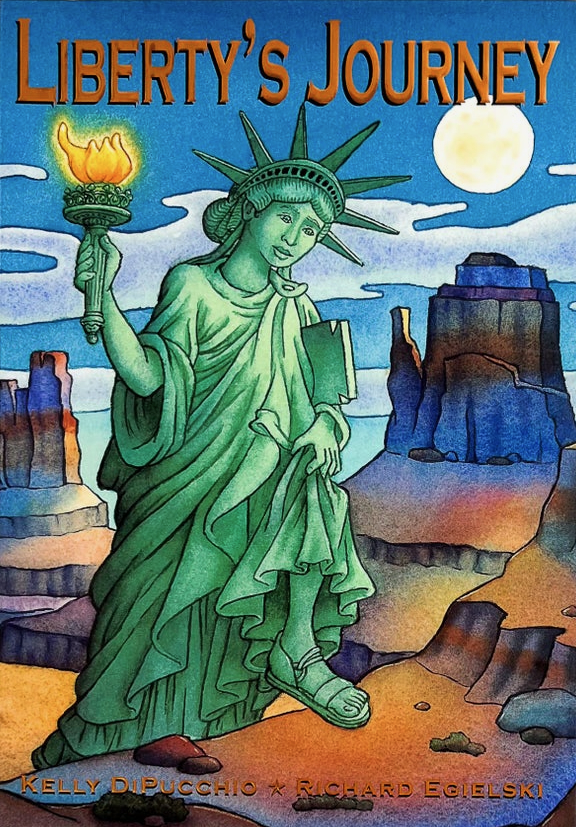
Title: Liberty’s Journey
Author: Kelly DiPucchio
Illustrator: Richard Egielski
Year Published: 2004
Length: 40 pages
The Story of the Statue of Liberty provides a great history of how the Statue of Liberty was built, from the inspiration, the fundraising, the transport, to its dedication in New York Harbor. Liberty’s Journey is a fun supplement, telling the story of how Liberty decides to explore our great country by going for a walk from sea to shining sea (and back again, once she received the letter begging her to return from the people of New York). We used this as a springboard to discuss fact vs. fiction, comparing the two stories. Our three-year-old enjoyed the discussion and was able to distinguish between the two.
time: 10 minutes
But no one talks about the fact that she is walking! This 150-foot woman is on the go!
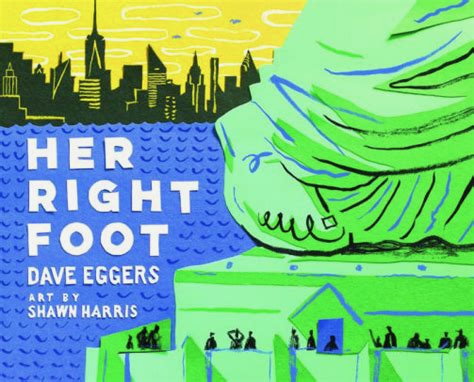
Title: Her Right Foot
Author: Dave Eggers
Illustrator: Shawn Harris
Year Published: 2017
Length: 112 pages
Her Right Foot is another great (non-fiction) story about the Statue of Liberty. Dave Eggers recounts the history of the Statue of Liberty. But he then goes on to point out something about Liberty that very few people notice: her right foot is clearly in mid-stride. Liberty is on the move!
time: 10 minutes
“You are the light of the world. A town built on a hill cannot be hidden. Neither do people light a lamp and put it under a bowl. Instead they put it on its stand, and it gives light to everyone in the house. In the same way, let your light shine before others, that they may see your good deeds and glorify your Father in heaven.
The Statue of Liberty, with her torch held high welcoming immigrants to America, evokes the enduring theme of “America is a shining city on a hill, whose beacon light guides freedom-loving people everywhere,” as President Ronald Reagan described us. President John F. Kennedy made a similar allusion before Reagan, as have many other politicians from both major parties. You can trace this back to John Winthrop, who wrote in 1630, “For we must consider that we shall be as a city on a hill, the eyes of all shall be upon us,” as he travelled to the New World as part of the Puritan Hegira. The Biblical scripture that inspired Winthrop was most probably from Jesus’ Sermon on the Mount in Matthew 5:14-16. Share this scripture with your child(ren); consider using it as an alternate memorization exercise to the line from the Lazurus poem.
time: 10 minutes
Bartholdi himself unveiled Liberty’s face and she stood, gleaming in all her glory, for everyone to see.
The author uses a number of words associated with erecting a gigantic statue that your child(ren) may not be familiar with: skeleton, copper, pedestal, unveiled, immigrants. Try introducing a couple of new words each day. Before you start reading, introduce the words you’ve selected for the day, define them, and then point them out during the reading.
time: 10 minutes
The Statue of Liberty is a truly unforgettable sight – a symbol of all that is America.
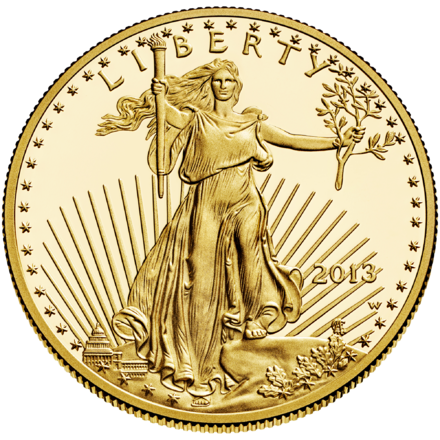
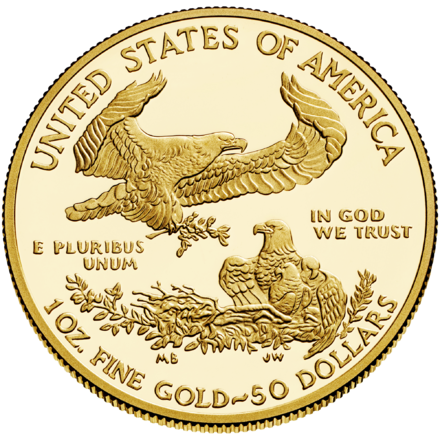
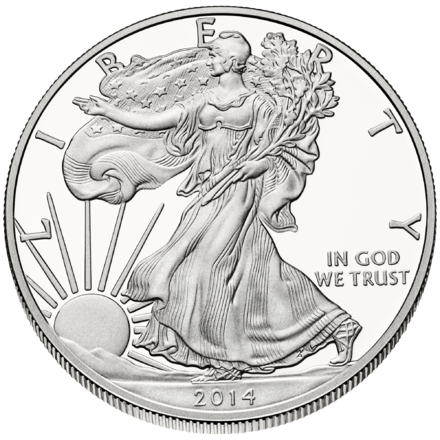
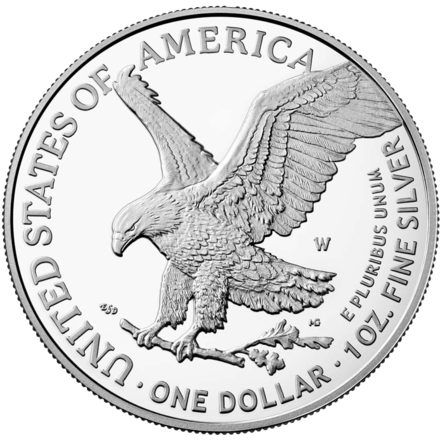
Liberty was one of the most popular symbols of America long before the Statue of Liberty was conceived. All of our coins not only had the word Liberty inscribed on them but also featured a figure of Liberty herself up until the Lincoln penny was introduced in 1909. Show your children some old coins (or pictures of old coins) to illustrate how far back this symbolism goes. Then show them pictures of the new bullion coins that were introduced in 1986 that revived some of the best Liberty coinage designs of the past.
Extend the exercise by asking your child(ren) to think of words that symbolize your own family. How would you symbolize those? Coat of Arms? Ask them to draw pictures of the symbols for your family.
Ask them if there are any other important symbols of the United States. (Flag, Eagle, Liberty Bell) Can they think of any other important symbols? (What does the cross symbolize to Christians?)
time: 10 minutes
With the help of a large New York newspaper, the money was raised. People all over the country, including children, sent in whatever they could.
Tens of thousands of people donated funds for the Statue of Liberty and her pedestal—including many children. Remind your child(ren) of this and then discuss with them some of the areas/causes where you donate your time or money. For older children, think about engaging them in your annual giving by asking them if there are any areas where they would like to give. They may be interested in causes associated with children, like Stanford Children’s Hospital or St. Jude Children’s Research Hospital.
time: 10-20 minutes
Liberty was put back together like a giant puzzle. The statue had been built not once, but twice!
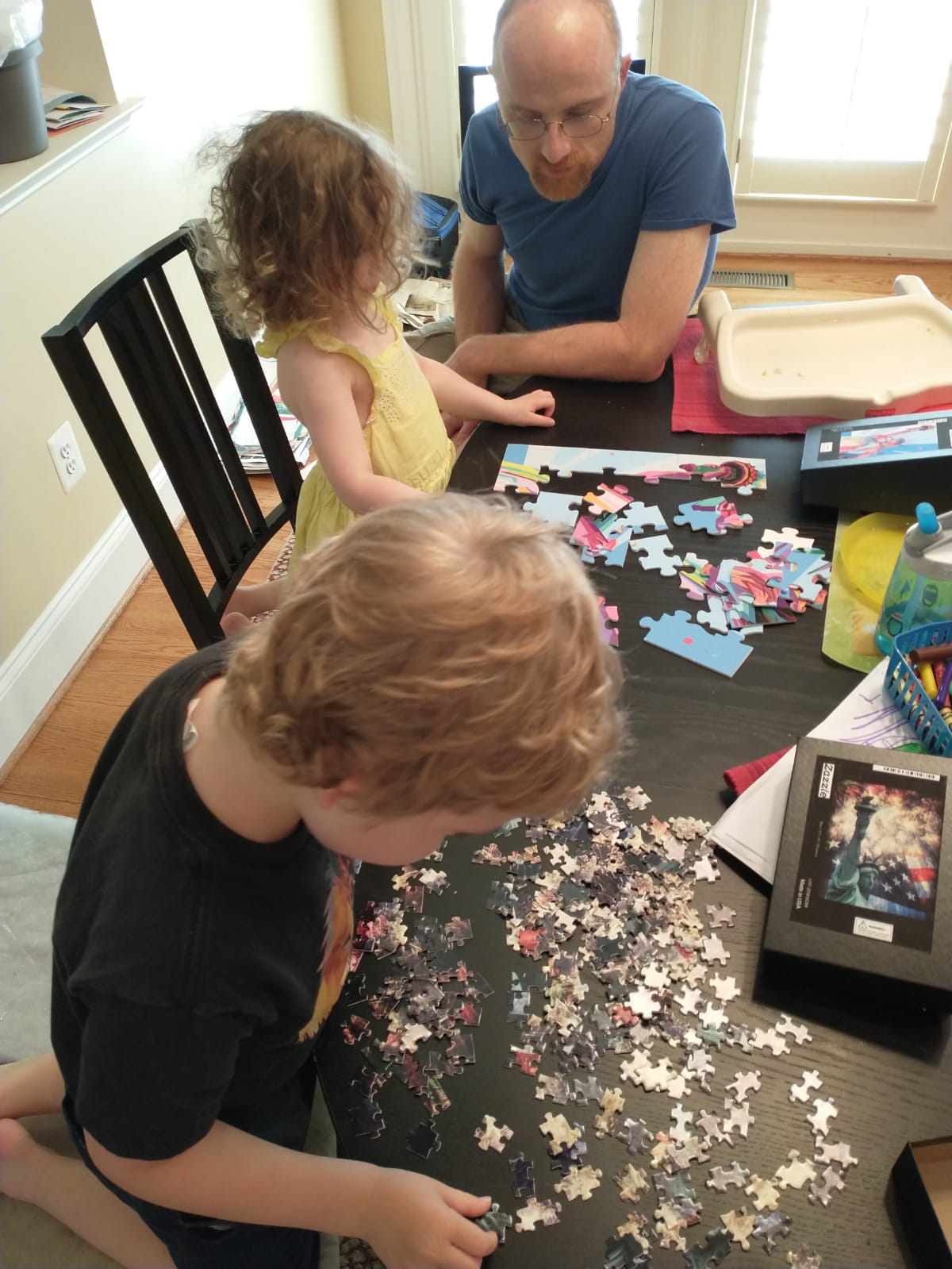
One of the amazing aspects of the history of the Statue of Liberty is how it was built twice, first in France and then in America. You can have some fun simulating this remarkable achievement with the help of a jigsaw puzzle. Ideally the puzzle would feature the Statue of Liberty, however, any puzzle will work. Our kids love jigsaw puzzles, so this activity works on a couple of levels. First, they enjoy putting the puzzle together. Then, they simulate crossing the Atlantic Ocean and reassembling the puzzle. You can use any barrier in your home as the Atlantic Ocean – a hallway separating rooms, stairs, a carpet. But the idea is that after assembling the puzzle in one location (France), they must transport it in chunks to another location (America), and then reassemble it. Ask your young engineers to brainstorm multiple ways to transport the “statue” (puzzle) from one “country” to another. Labeling the two locations with the appropriate country helps drive the lesson home.