



America is a nation of immigrants. Throughout the 1800s, wave upon wave of immigrants washed up on our shores. The biggest waves were from Ireland, Germany, Italy, and China but smaller waves also came from Scandinavia, France, Poland, Japan and many other countries. Protestants, Catholics, Jews – millions of people, coming from diverse cultural, national, and religious backgrounds, needed to be assimilated and united as Americans. Our national motto reflected this: E Pluribus Unum.
They came seeking opportunity. For some, it was economic opportunity; the chance to make a better life for themselves and their families. For others, it was the opportunity to worship without fear of persecution. America, with its beacon of Liberty, called to peoples from all different ethnic, national, and religious backgrounds. E Pluribus Unum.
These people shared important traits in common. They were self-reliant risk takers, willing to leave behind what they knew in their old world in search of a new life in a strange new country, willing to work hard to forge a future for their families, willing to help others as they were helped by the ones who came before them. Together, they contributed key elements of American Exceptionalism. E Pluribus Unum.
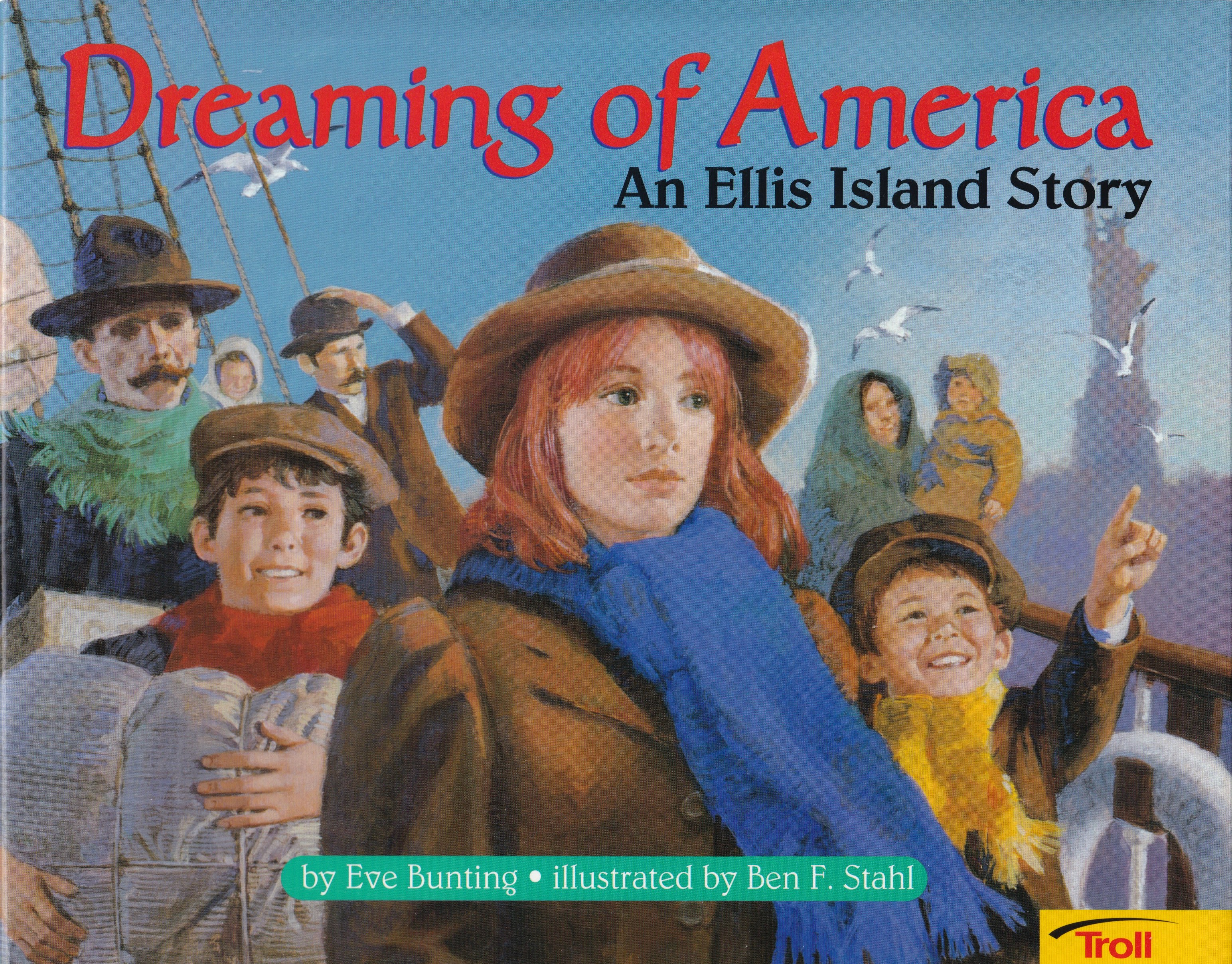
Title: Dreaming of America: An Ellis Island Story
Author: Eve Bunting
Illustrator: Ben F. Stahl
Year Published: 2000
Length: 32 pages
Below is one suggestion for your week with the book Dreaming of America. Please experiment with what works for your family! (Note: not all activities are included in the suggested sample week below).
toc: "American Heritage Songbook: _America_"
time: 5 minutes
freq: daily
Everywhere around the world They’re coming to America Ev’ry time that flag’s unfurled They’re coming to America Got a dream to take them there They’re coming to America
Written and performed by Neil Diamond, this tribute to America sings the praises of all the immigrants who left their homes behind to pursue their happiness in America. Attracted by “Free, only want to be free,” these immigrants are guided to America by “Freedom’s light burning warm.” A highlight of the song comes near the end, where he recites the opening lyrics of My Country ‘Tis of Thee:
My country ‘tis of thee Sweet land of Liberty Of thee I sing
Released in 1981 as part of the soundtrack for The Jazz Singer, the song reached #1 on the Billboard Adult Contemporary list and #8 on the Billboard Hot 100. It has since become an iconic song about America, with Diamond performing it at the centennial re-dedication of the Statue of Liberty in 1986, as part of the Capitol Fourth on the south lawn of the Capitol on July 4th, 2013, and many other venues.
For a version with lyrics on screen and great background images, sing along with this version. YouTube has other creative versions featuring historical immigrant images and videos which are my personal favorites. Finally, in this 2012 live version, Neil Diamond dedicates the song to his grandmother who immigrated to America from Kiev, Russia. Diamond, who was inducted into the Songwriters Hall of Fame in 1984, says that this song is the one he is most proud of writing.
toc: "American Heritage Songbook: _The Great American Melting Pot_"
time: 5 minutes
freq: daily
Yes, we included two songs for this module. We had two great songs about our immigrant heritage so we decided to include them both.
You simply melt right in It doesn’t matter what your skin It doesn’t matter where you’re from Or your religion, you jump right in Oh, what a stew, red, white, and blue America was the new world and Europe was the old. America was the land of hope, or so the legend told. On steamboats by the millions in search of honest pay Those 19th-century immigrants sailed to reach the U.S.A.
Lovely Lady Liberty with her books of recipes and the finest one she’s got Is the great American melting pot The great American melting pot What good ingredients, Liberty and immigrants.
Schoolhouse Rock! was a series of short animated educational musical videos that started in 1973. Nominated for a Daytime Emmy eight times for Outstanding Children’s Instructional Series, it won four times (1976, 1978, 1979, 1980). From 1975 to 1976 their videos focused on our political system in a series of ten musical animations known as America Rock! Our kids love the one about immigration, The Great American Melting Pot. The “melting pot” metaphor is an enduring theme of our exceptional American heritage. The lyrics and catchy tune of The Great American Melting Pot are a great way to introduce your child(ren) to this theme.
Lovely Lady Liberty with her books of recipes and the finest one she’s got Is the great American melting pot The great American melting pot What good ingredients, Liberty and immigrants.
There is a YouTube version of it here. However, if you subscribe to Disney+ you can watch a better quality version of it there. Or you can purchase the entire set of America Rock! songs here.
time: 15-20 minutes
prep: 30-45 minutes
supplies: fleece or fabric, scissors, ruler
There was a scarf for each of them, a red one for Anthony, yellow for Philip, and blue for Annie. “When did she ever knit these?” Annie asked. “I didn’t see her making them.”
See: How To Make a Winter Scarf (Crafts for Kids #4).
Alternatively, take the scarf and make several small cuts on either end to form fringe. I found that even with significant guidance, my six year old had trouble cutting through fleece so this was a difficult activity in which to include the children in. See: No-Sew Fleece Scarf for Kids.
If you don’t want to deal with fabric, here is a paper scarf.
time: 10 minutes
supplies: Globe
“I am Viktor Kirschenblatt, from Russia. I boarded ship at Liverpool.”
You need to read the Afterword to learn that the SS Nevada began its Atlantic crossing from Cobh (pronounced COVE), Ireland before ending it at Ellis Island, New York. Mr. Viktor boarded the Nevada at Liverpool, England; the story does not tell us how he got from Russia to Liverpool.
For this activity, we will trace Mr. Viktor’s journey: starting in Russia, boarding the ship at Liverpool, England, stopping in Cobh, Ireland to pick up Annie and her brothers, crossing the Atlantic to Ellis Island, and finally traveling to his new home in Philadelphia, Pennsylvania.
Using a globe, online map, or coloring page of the world (or Europe), show your kids how far Mr. Viktor had to travel from Russia to Liverpool, England. Even before he meets Annie and her brothers, he has traveled a long way.
Next, show them that it was just a short voyage from Liverpool, England to Cobh, Ireland. Compare the distance of this short voyage to the long voyage of the Atlantic crossing between Cobh and Ellis Island, New York.
The last leg of Mr. Viktor’s journey was from New York to Philadelphia. We don’t know how he did this. Show your kids how he could have traveled over either land or on the ocean to reach Philadelphia.
Bonus: Maps vs. Globes. On a flat map, stretch a small piece of string to find the shortest path between Ireland and New York. Depending on your map projection, you may notice that it goes through Greenland. Now do the same exercise on a globe. This shortest path lies along a “great circle”: if you extend the path in a straight line, it would form a circle around the globe the same distance as (but somewhat off-axis from) the equator. If you plot this course on a flat map, you’ll notice that it forms an arc. You can also see great circles in cross-country or international flight routes. These arcs may not seem like the shortest path, but because of the distortion inherent in flat maps, they really are!
time: 5 minutes
freq: once
E Pluribus Unum
E Pluribus Unum was the unofficial motto of the United States of America up until 1956, when Congress officially designated In God We Trust as the motto. Originally meant to signify how thirteen separate colonies became one nation in 1776 during the War for Independence, it made its first official appearance as part of the design of the Great Seal of the United States and is also incorporated into the Seal of the President. The motto first appeared on U.S. coins in 1795 and has appeared on most coins since then; the Coinage Act of 1873 made it a legal requirement on all United States coins.
E Pluribus Unum evokes a powerful sense of unity for a nation of immigrants. We should not be celebrating a diversity which contends that “all cultures are of equal value.” Down that road leads the path to the balkanization of the United States. E Pluribus Unum encourages people from all over the world to join America to share in our political ideals and shared civic culture.
It is not an accident that people everywhere follow the beacon of freedom to our shores. Nor that arguably we are the most successful at assimilating people from different cultures into ours – it is part of our DNA, our American exceptionalism, that for almost 250 years one of our ideals and mottoes has been E Pluribus Unum.
This is a short memorization exercise for your child(ren). But just to make it a tad more challenging, it is in Latin. To make it more fun, give your kids a handful of change and ask them to locate the motto on the different coins.

time: 60-90 minutes
prep: 30-45 minutes
supplies: butter, sugar, eggs, flour, vanilla, baking powder
Never was a mince pie so good! She picked up a juicy currant that had fallen on the blanket and popped it in her mouth.
You can simplify this recipe by purchasing pre-made pie crusts. Or you can make your own using the recipe below (we modified this Traditional British Mince Pie recipe):
time: 30-60 minutes
prep: 10-15 minutes
supplies: dry ice, ice cubes, clear jars, food coloring, dish soap, insulated gloves or tongs, can of soda
She longed, too, for the smell of mothballs Auntie kept in her wardrobe. She’d never thought she’d miss the smell of mothballs.
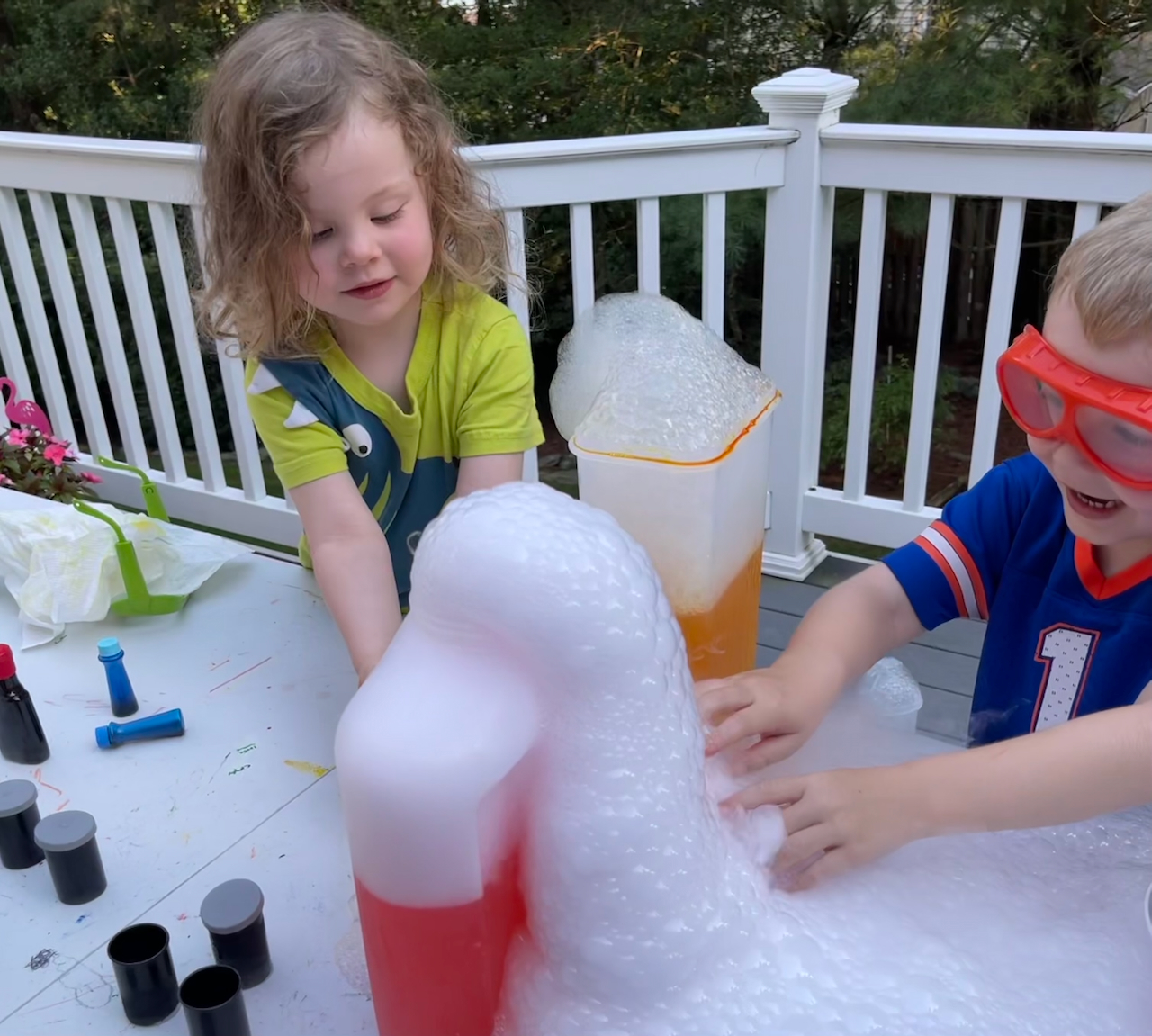
Mothballs undergo sublimation: a long word that just means they change directly into a gas from a solid without going through a liquid phase. You can have a lot of fun demonstrating sublimation to your kids with dry ice (which is actually frozen carbon dioxide).
Warning: these experiments should be done under adult supervision. Touching dry ice can damage the skin. For the sake of safety, use insulated gloves and/or tongs to handle it.
There are a lot of fun experiments you can do with dry ice. We did several and the kids loved them. Below is a description of a few simple ones. The last one is a bit messy but quite fun. Protect your table and floors or, better yet, experiment outdoors!
This experiment should be done outside (it can be done inside but make sure you put down towels or newspapers to catch any overflow :-)
toc: "Re-enactment: Crossing the Atlantic in Steerage"
time: 30-45 minutes
prep: 10-20 minutes
supplies: large box, pillows, chocolate gold coins
“Isn’t this the nice wee room, now?” Annie asked shakily. “Cozy, just for the three of us.” In truth, it wasn’t cozy, and not that nice, either. There were no windows in their cabin. “What’s that noise?” Little Philip held his hands over his ears. “It’s the big engines that make the ship go,” Annie shouted. “I think we’re right on top of them.”
To simulate the cramped, awkward conditions of traveling to America in steerage, you will need a box large enough for 1-3 children. Have your children climb into the box, give them a couple of pillows to make them “comfortable,” and then close it up (no windows!). Then, start banging (gently) on the side of the box to simulate the sound of the engines. And finally, lift the box up (you’ll need at least two adults for this part), and start tilting it side-to-side to simulate the motion of the ocean (make sure you stop before the kids get seasick!). Or you can do what we did and use a large blue bean bag to represent the Atlantic Ocean. Place your box on it, the kids in the box, and then rock the bean bag to simulate the storm.
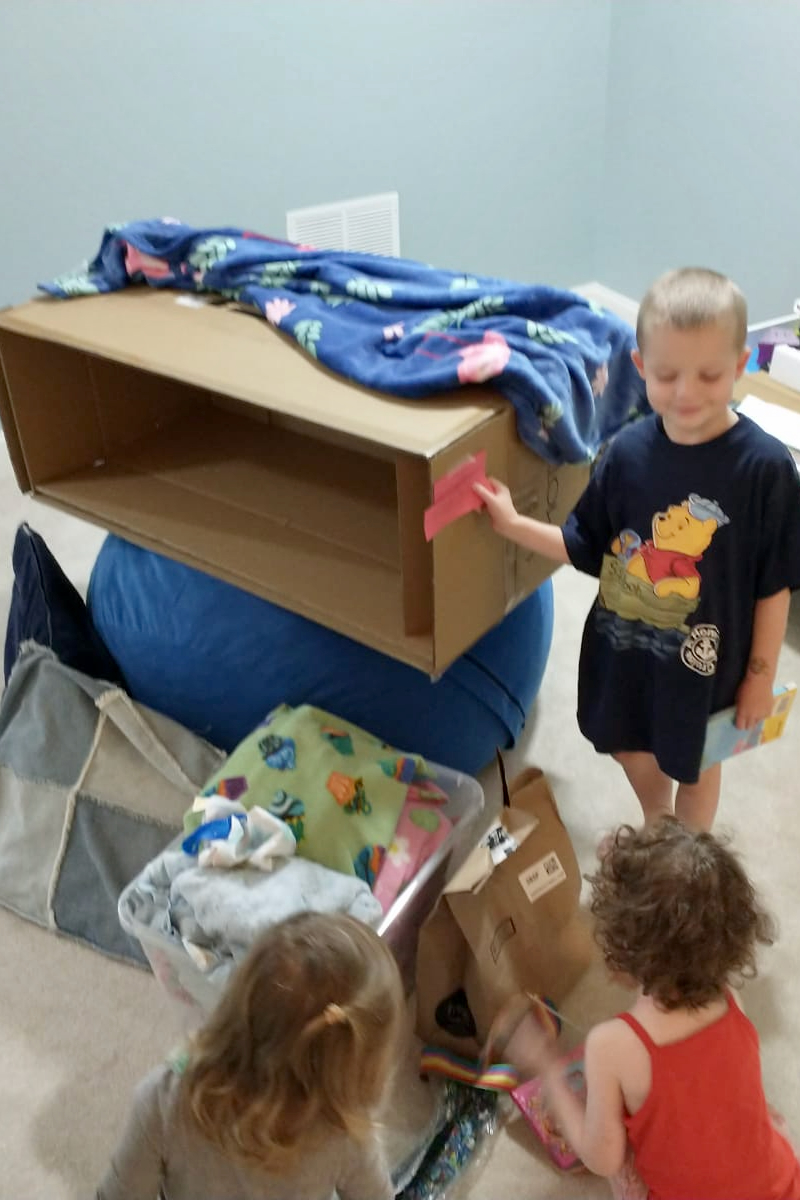
The kids before entering their “wee, cozy room.”
Now, open up the box and ask them to “disembark” by standing in line and answering some questions from the “immigration official:” What is your name? What country are you from? Where are you going? You can prep the kids ahead of time with family history. Pick an ancestor or friend who immigrated to America: which country did he or she come from? Which state did they settle in? Our kids wanted to be the Moore children rather than an ancestor.
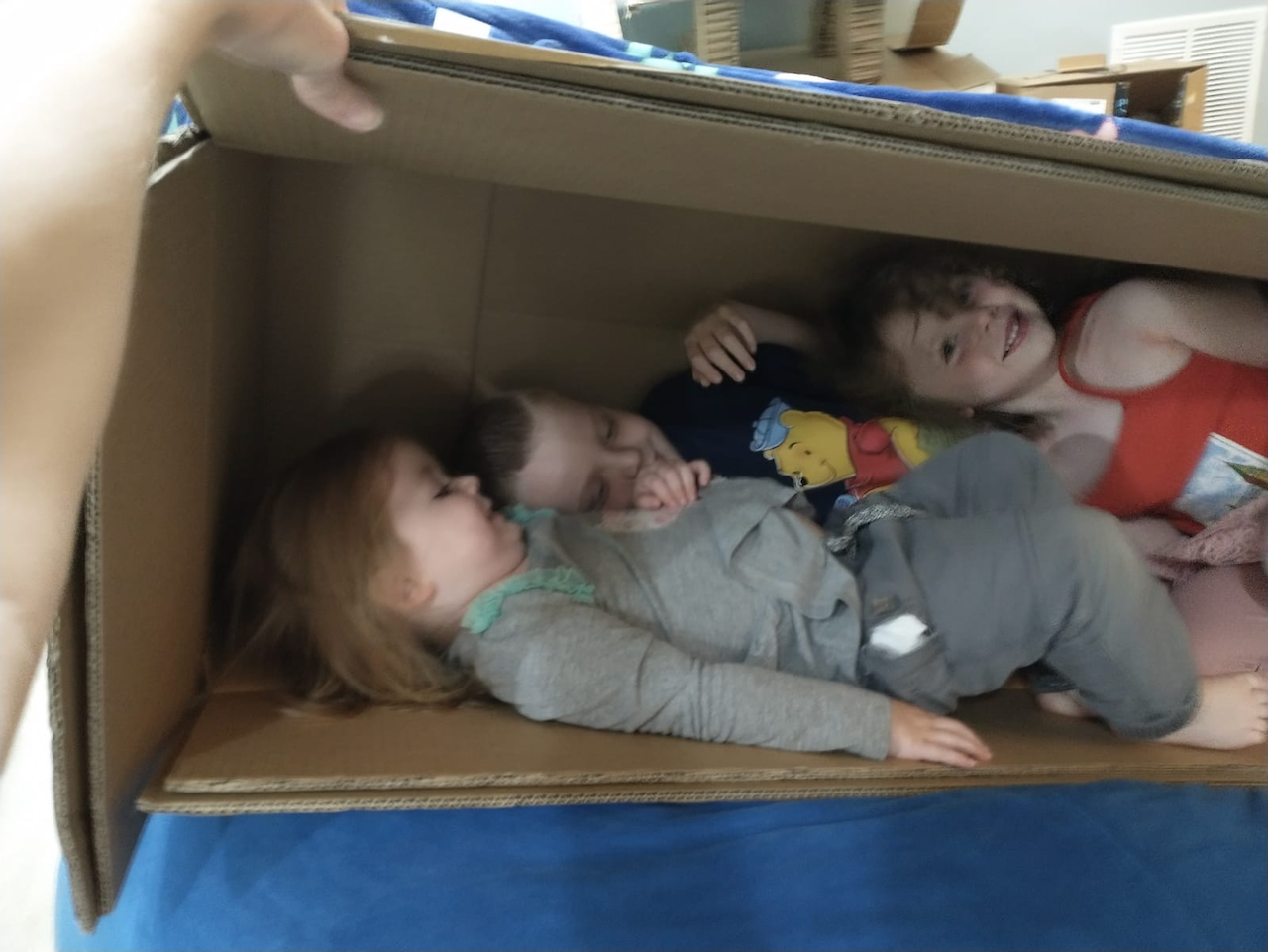
The kids after entering their “wee, cozy room.”
Complete the immigration re-enactment with a celebration ceremony for being the “first” to immigrate through “Ellis Island.” Part of your ceremony could include eating Mince Pie (see the Cooking activity) or the ice cream and melted M&Ms from The Great American Melting Pot II activity below. Or just distributing chocolate gold coins as we did.
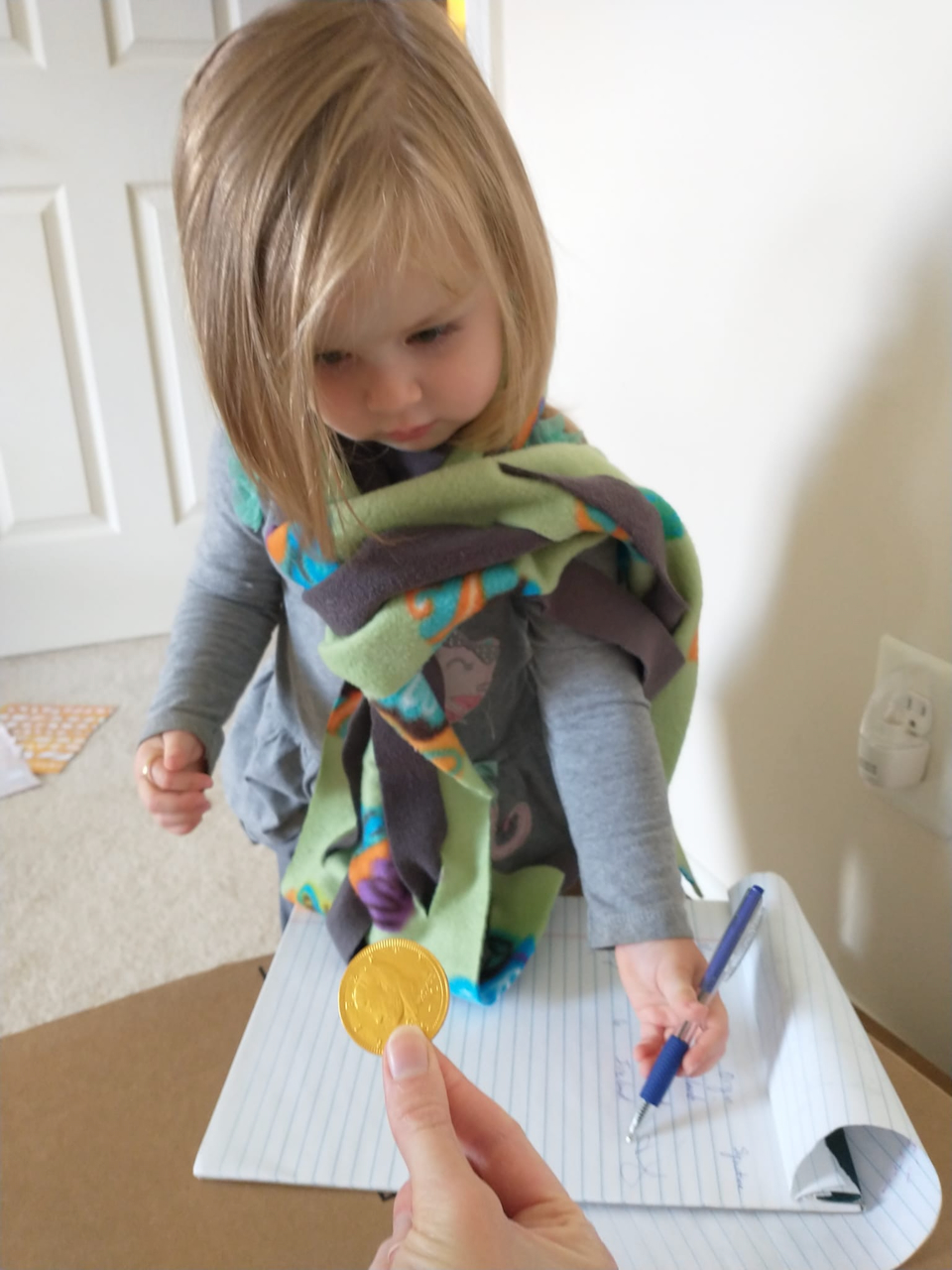
Wearing her new scarf and registering at Ellis Island.
time: 10 minutes
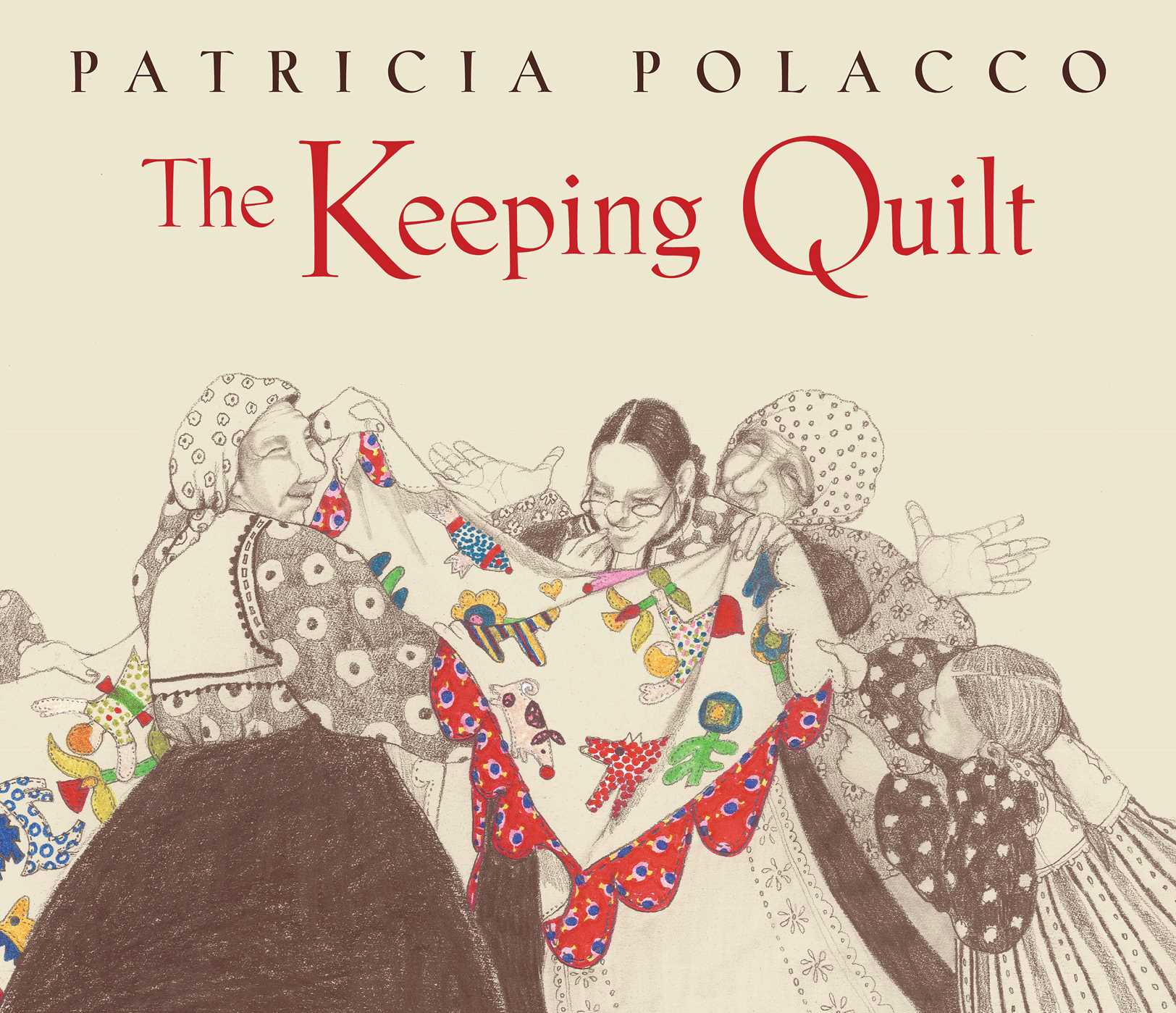
“We will make a quilt to help us always remember home,” Anna’s mother said. “It will be like having the family in backhome Russia dance around us at night.”
Title: The Keeping Quilt
Author: Patricia Polacco
Illustrator: Patricia Polacco
Year Published: 1988
Length: 32 pages
Patricia Polacco is the author and illustrator of this autobiographical coming-to-America story. Her great-great grandmother, a Russian Jew like Viktor in Dreaming of America, immigrated to America. To remind her great-great grandmother of the people they left behind, she and her mother made a quilt from fabrics worn by their relatives.
Through multiple generations, all the way through Polacco’s own children, the quilt is brought out for special family occasions. Stories about the quilt and the lives it has touched become an important means of passing family history down to each new generation. Young readers should pay close attention to the weddings, as they slowly change over the generations. And ask them why Anna’s dress is in color but all the other dresses are not?
time: 10 minutes
For we were all baptized by one Spirit into one body – whether Jews or Greeks, slave or free – and we were all given the one Spirit to drink.
There is a beautiful parallel between this scripture and America’s motto of E Pluribus Unum. Just as we all become one body after accepting Jesus Christ as our savior, America brings together peoples from all cultures and countries who are willing to share our values: from out of many, one. Ask your kids to memorize this scripture along with the short motto, E Pluribus Unum.
time: 10 minutes
Her decks were abustle with men, women, and children, some still dragging their trunks and boxes.
The young reader will encounter several new words about traveling aboard ships: abustle, steerage, wharf, port. In addition, there are some words that remind Annie and her brothers of home: mothballs, currants, and rubies. It’s always nice to ask your kids if they have an idea of what the words mean from the context of the story, after reading it to them a couple of times. That is, unless they ask in the middle of the story.
time: 10-20 minutes
“May we ask why you are going to America, Mr. Viktor?” “I have a son in Philadelphia.” He shrugged. “It is also very dangerous to be a Jew in Russia.”
Many immigrants came to America to escape religious persecution; among these were the Jews, who formed their own immigration wave in the 1800s, coming from Germany first and, later in the century, from Russia, Poland, and eastern Europe. The First Amendment to the Constitution (known as the “Establishment clause”) promises freedom of religion from state influence:
Congress shall make no law respecting the establishment of a religion, or prohibiting the free exercise thereof.
America’s values are based on a shared Judeo-Christian heritage. The First Amendment, coupled with our propensity to start new organizations whenever we see a need, has allowed a huge number of organized religious groups to flourish and spread, contributing greatly to the pluralism of American society. Today, this includes many religions that do not share our Judeo-Christian roots yet are still welcome.
The “Spot the Church” activity is meant to highlight religious pluralism in America. Ask your kids to “spot the church” every time you go for a drive with them. Try to remember which churches they see and make a list when you get home. See how many different houses of worship they can find in a week. Try driving some new routes to familiar places in order to help them Spot the Churches!
time: 20-30 minutes
prep: 15-20 minutes
supplies: coloring sheet, crayons, M&Ms, melting pot, ice cream
I am Annie Moore of Cork, Ireland, she thought. And I am Annie Moore of America.
A unique aspect of America is the set of ideals it is built upon and to which it aspires. These ideals attract immigrant families from countries all over the world. In the 1800s these immigrants came in waves with one of the largest (and first) waves coming from Ireland. During the 1840s, half of all immigrants to America were Irish as many fled the Potato Famine. Later waves included Germans, Italians, Chinese, and Japanese. Each of these immigrant waves brought different cultural influences to America, impacting America’s culture in different ways and to different degrees.
For this activity, trace the ancestry of your children and identify the countries of origin for each ancestral branch. You can use the simplified Family Tree diagram (included with this module) to fill in the names of at least three generations, starting with the kids, parents, and grandparents. On a coloring map of the world (or maybe a single continent), use a different color for each country in their ancestry using only the colors found in a standard package of M&Ms (red, green, yellow, blue, orange, brown – for more colors, include pastel M&Ms). Have them color in the squares on the family tree, matching the color to the country of origin (use stripes or sub-squares for ancestors with mixed origins).
Then, ask them to select M&Ms that match the country (or countries) of origin for each of their ancestors. (If their ancestors happen to be from just a single country, just use all the colors!) Place those M&Ms in a single layer on a plate if melting in a microwave (see directions, don’t forget the step where you “crush” the M&Ms after the first microwave; it took us a couple of tries to get it right — we burned them on our first try) or a double boiler (see directions) and apply low heat until the M&Ms have melted into an homogenous chocolate mix. Show the kids how a) the chocolate has melted and blended into a single color but b) the mixture still retains bits of candy coating that represent parts of the original culture that are retained after blending in the Great American Melting Pot. After this illustration of The Great American Melting Pot, scoop some vanilla ice cream and pour the melted chocolate onto it and serve. Yum!