



Thomas Edison and Henry Ford are two of the greatest inventors, industrialists, and businessmen in America’s history. From electric lights to recorded music to automobiles, we are surrounded by the products they brought into everyone’s home to this very day. And the secret to their success is a key component of American exceptionalism: persistence and hard work.
America’s free enterprise economic system provides the incentives that created this work ethic. An economic system that rewards hard work, creativity, and innovations encourages everyone to contribute, creating an enduring civic culture of industriousness and self-reliance.
People remember Ford and Edison for the products they created that improved the lives of everyday Americans. But it’s the personal character traits underlying their success that are celebrated in this story. These men “kept at it” until they succeeded.
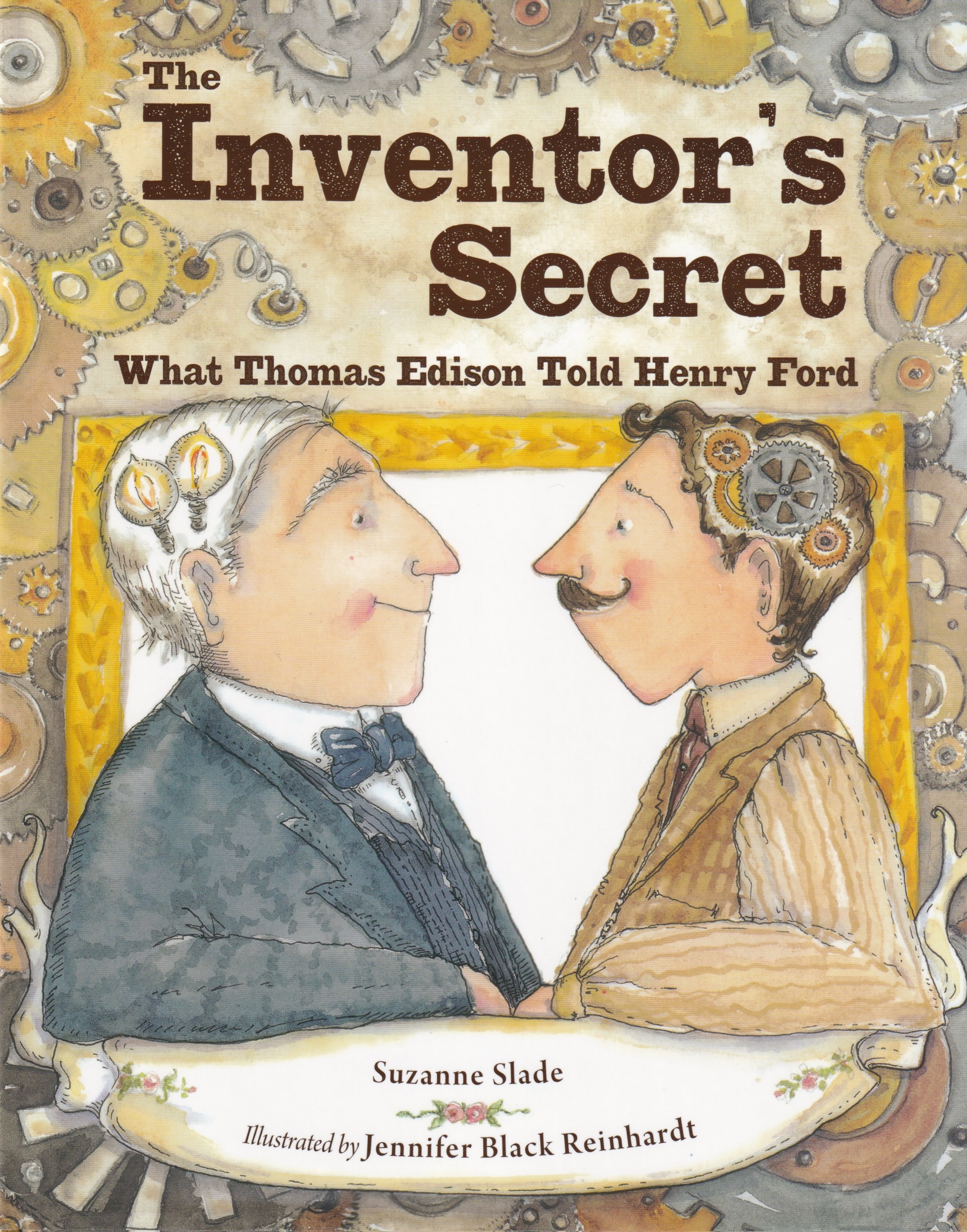
Title: The Inventor's Secret: What Thomas Edison Told Henry Ford
Author: Suzanne Slade
Illustrator: Jennifer Black Reinhardt
Year Published: 2015
Length: 48 pages
Below is one suggestion for your week with the book The Inventor’s Secret. Please experiment with what works for your family! (Note: not all activities are included in the suggested sample week below).
toc: "American Heritage Songbook: _Electricity, Electricity_"
time: 5 minutes
freq: daily
Electricity, Electricity is part of the “Science Rock” set of Schoolhouse Rock! videos/songs. Its opening verse connects electricity to Edison’s light bulbs:
When you’re in the dark and you want to see You need, uh . . . electricity, electricity Flip that switch and what do you get? You get, uh . . . electricity, electricity Every room can now be lit With just, uh . . . electricity, electricity
You can find it on YouTube or Disney+.
time: 10 minutes
prep: minimal
supplies: straws, construction paper, tape, scissors
Models C, F, K, and N weren’t quite right either. Henry grew tired. How many letters would it take?
Download this coloring sheet of Henry Ford’s Model T (courtesy SuperColoring) and turn your kids loose with their crayons and markers. They may want to use this as a color blueprint for designing their own Model T below.
time: 10 minutes
prep: minimal
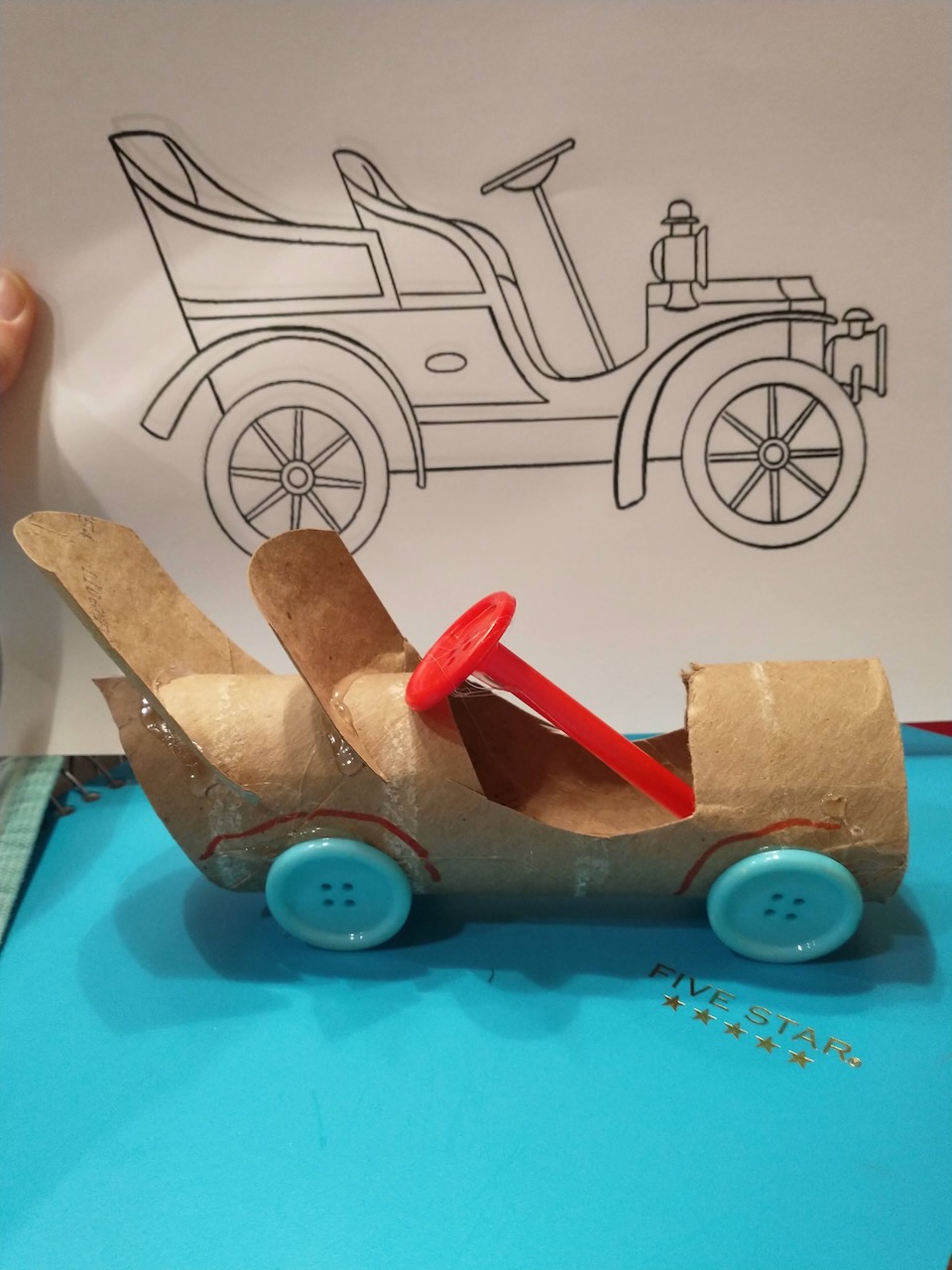
supplies: paper towel tube, hot glue gun, scissors, straw
Finally he made a special car – the Model T (though most people called her Tin Lizzie). Lizzie was light, fast, and had four powerful cylinders.
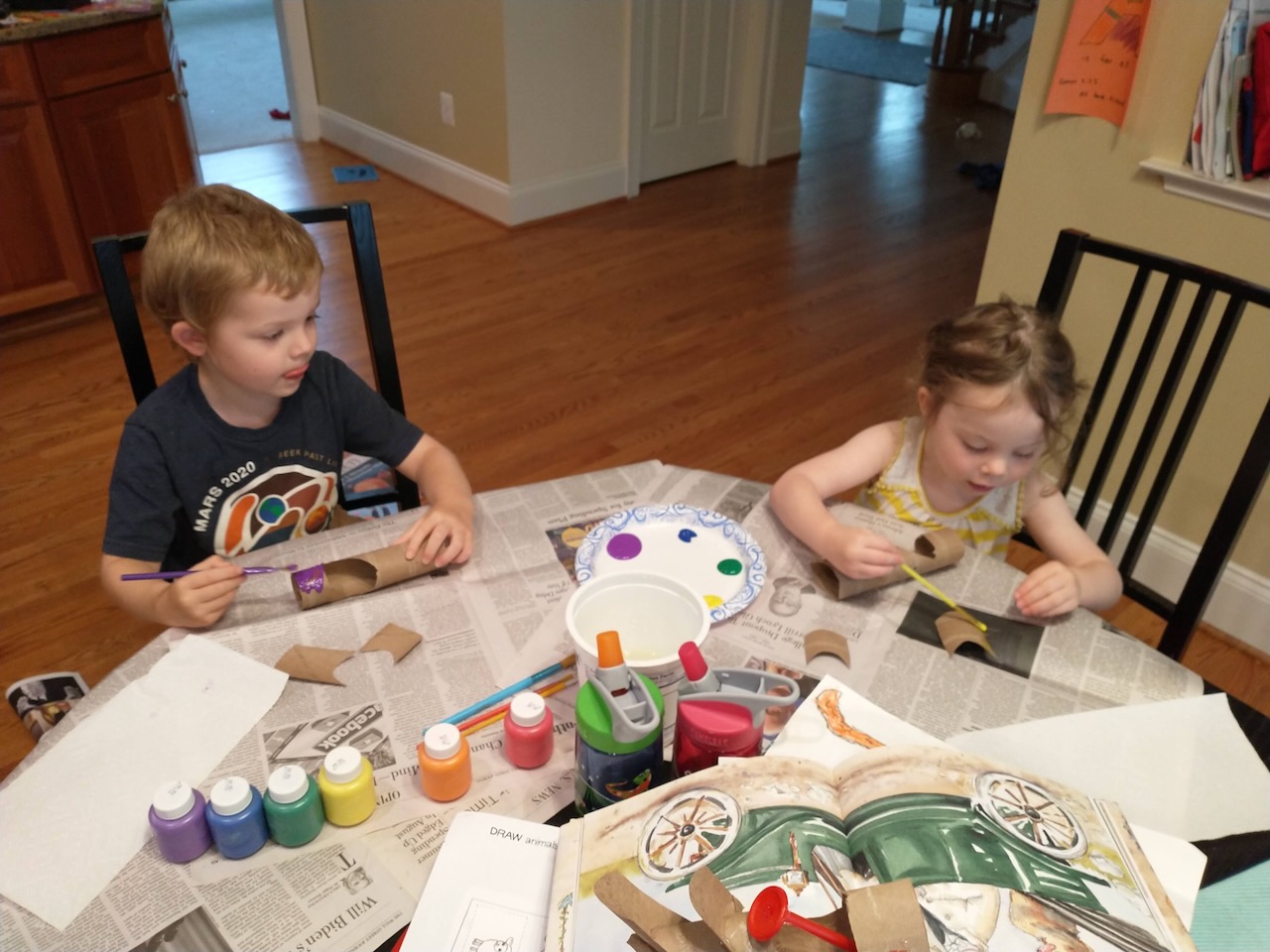
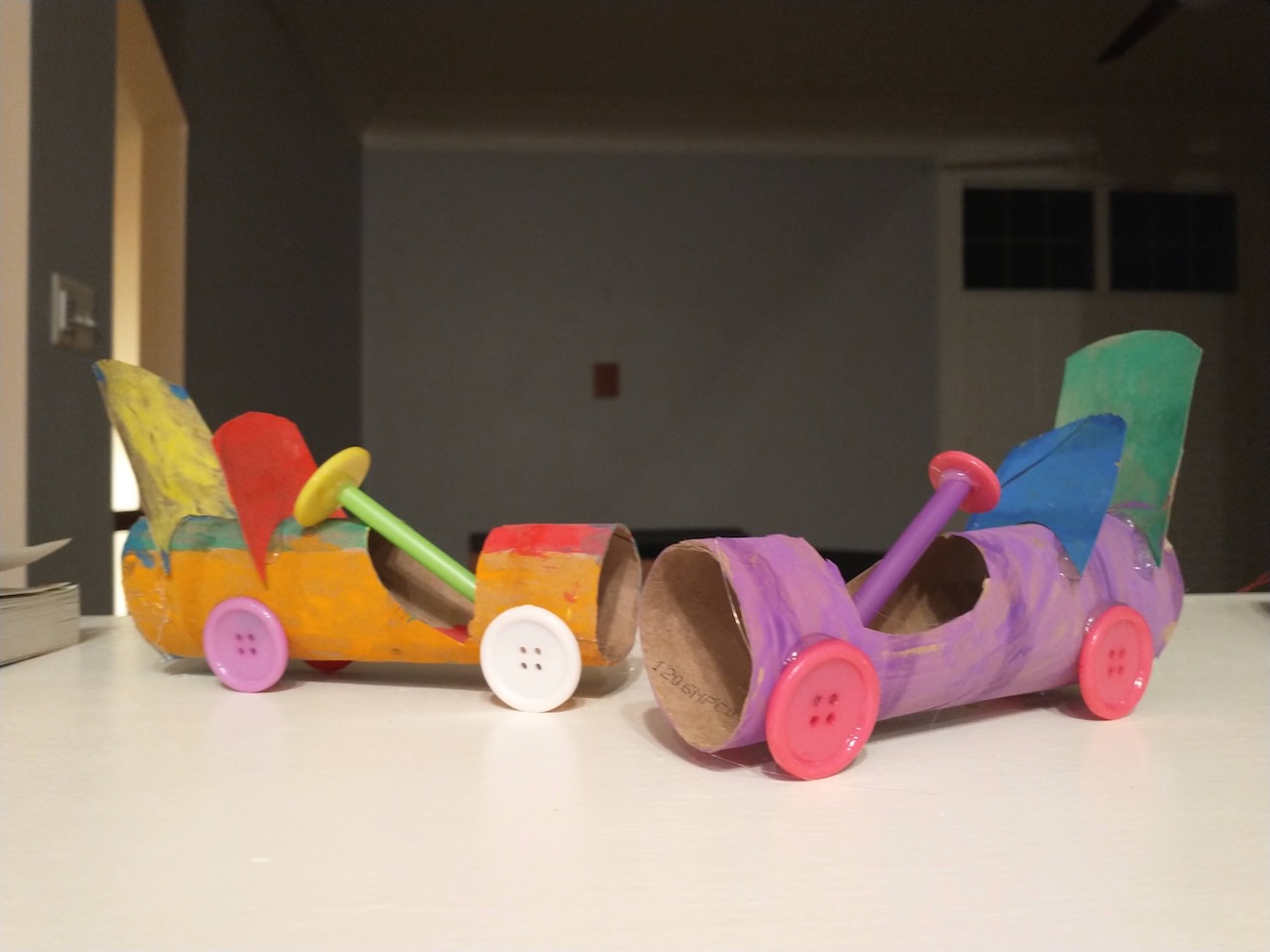
The craft below is adapted from Meraki Mother: Racing Car Craft for Kids.
time: 10 minutes
supplies: Puzzle map of the United States
So Henry hopped a train in Detroit and chugged six hundred miles to New York City.
On your puzzle map of the United States (or paper map), locate the states of Michigan and New York. Which states did Henry have to travel through to get to New York City? Pull them out of the puzzle and assemble them together (or color them in on your paper map). Why do you think Henry took a train to New York City instead of driving or flying?
time: 5 minutes
freq: once
If a young man makes up his mind to work, there is no limit to what he can do. - Henry Ford
Opportunity is missed by most people because it is dressed in overalls and looks like work. - Thomas Edison
The Henry Ford quote comes from this 1929 radio interview of Henry Ford, Thomas Edison, and Harvey Firestone, part of celebrating the 50th anniversary of Edison’s light bulb. Ford makes the comment at the 40 second mark of the two-minute video. Edison also speaks on the value of hard work and education. Watching the short video will show your child(ren) that Ford and Edison are real men, not just characters in a story.
Ask your child(ren) to select one of the quotes and memorize it.
time: 20 minutes
prep: 10-15 minutes
supplies: butter, sugar, eggs, yogurt, lemon, flour, vanilla, baking powder, baking soda, salt
Henry did some fast talking and got invited to a big dinner with Thomas as the guest of honor.
Ruth Graves Wakefield, proprietor of the Toll House Inn in Whitman, Massachusetts, is credited with popularizing the Chocolate Chip Cookie we know today. She developed the recipe in 1938 when she was trying to invent a unique dessert for her guests. She sold the recipe to Nestle in exchange for a lifetime supply of chocolate.
However, as is so often the case, Wakefield’s invention built on the work of earlier culinary experiments. In Bravetart: Iconic American Desserts, author Stella Parks, traces the ancestors of today’s chocolate chip cookie to the latter half of the 19th century when chocolate became less expensive and thus more affordable for experiments. She finds recipes for “chocolate jumbles” in the 1870s with nearly identical ratios to the ingredients used in our modern chocolate chip cookie. The main difference? They were a lot more work because the chocolate had to be grated.
So, about the same time Edison was inventing the light bulb in the 1870s, American chefs were inventing the chocolate chip cookie. However, to honor Ruth Graves Wakefield and Nestle for popularizing the Toll House Chocolate Chip Cookie back in 1938, buy a package of Nestle’s Semi-Sweet Morsels, and follow the recipe on the back for a truly iconic American dessert experience.
time: 10-15 minutes
prep: minimal
supplies: bicycle
Most of all, Henry was curious about engines – machines that chugged and purred, hiccuped and whirred.
Simple machines redirect and transform forces. There are six classical types of simple machines: (1) inclined plane, (2) lever, (3) pulley, (4) wheel-and-axle, (5), wedge, (6) screw. The key idea behind all of these is that these machines help us to do things we couldn’t otherwise have done. Henry Ford’s engine uses ideas from these simple machines (along with some explosive chemistry) to redirect the force from exploding gasoline in the cylinders to move the car wheels.
Of the six simple machines the wheel-and-axle is probably the most pertinent to the story and easiest to demonstrate with the help of a bicycle. Turn a bicycle upside down and have your child(ren) spin the pedal to turn the wheel. Point out to them how the force they are applying to the pedal is translated by gears to a force that turns the wheel on the axle of the bicycle.
Depending on the type of bicycle, you may be able to turn the wheel backwards and see the pedals turn (which gives the inverse advantage). If you have a multi-speed bicycle you can demonstrate changing gears. Let them turn the pedals in the highest and lowest gears? Then ask them, which is easier/harder to turn? Which makes the wheel go slower/faster? At lower gears, the pedals are easier to turn, which allows one to apply more force to get the acceleration necessary to get up to the desired speed.
toc: "Re-enactment: Make Your Own Assembly Line"
time: 15-20 minutes
prep: minimal
supplies: 8.5" by 11" sheets of paper
Then he remembered. Thomas had changed his lightbulb design thousands of times before he got it right. So Henry kept at it.
Henry Ford is famous for more than the cars he built. He is also famous for the way he built those cars. Ford invented the moving assembly line for building cars, which revolutionized manufacturing. Assembling a Model T went from over 12 hours to just 93 minutes.
For this activity, you and your child(ren) will create your own paper airplane assembly line. This activity is more fun with more people, so consider inviting extended family or another homeschooling family to join you. You need enough people for a short assembly line but the ideal is to have two assembly lines set up that compete with each other on maximizing paper airplane production (and flight!).
To demonstrate how worker specialization and teamwork increase productivity with an assembly line, first try making paper airplanes without one. Show your child how to make a Basic Dart paper airplane (five folds). Then, time them for three (or five) minutes to see how many they can make by themselves. As a Quality Assurance step, have them fly the airplane. If the airplane doesn’t fly at least ten feet, it doesn’t count as a completed airplane. (Place a line of string or other marker down so they know whether they’ve succeeded on each flight.)
Next, build your assembly line. Depending on how many people you have, assign them different roles:
You should find that after running through the five-minute work “day” a couple of times, your team has become highly proficient at building (and flying!) paper airplanes – and that their production rate as a team is much better than it is as a group of individuals working independently. They should also see their production rate increase after they have run through a couple of “days” because they are improving as they practice whichever role they are doing. And hopefully your kids will get as caught up as ours did in the excitement of building and flying as many airplanes as they can in a short period of time. Of course, you will then be faced with what to do with a houseful of paper airplanes.
toc: "Re-enactment: Meals by Candlelight"
time: 15-20 minutes
prep: minimal
supplies: candles
Meanwhile, Thomas was working on an electric light so people could read past dark. After changing his design many times, he created an incandescent lightbulb that burned all night!
We wanted to highlight the importance of the lightbulb by having an evening without them. We lit candles instead of turning on the lights one evening. We made dinner, ate dinner, and got ready for bed by candlelight. Note that this was not done completely without electricity - we used the refrigerator.
We pointed out how it was dimmer, messier, more dangerous to use candlelights instead of lightbulbs. After dinner, we got ready for bed and then went straight to bed (no stories) because it was hard to do things with so little light.
This activity works best in winter when it gets dark early.
time: 10 minutes
How could he help himself swim like a fish?
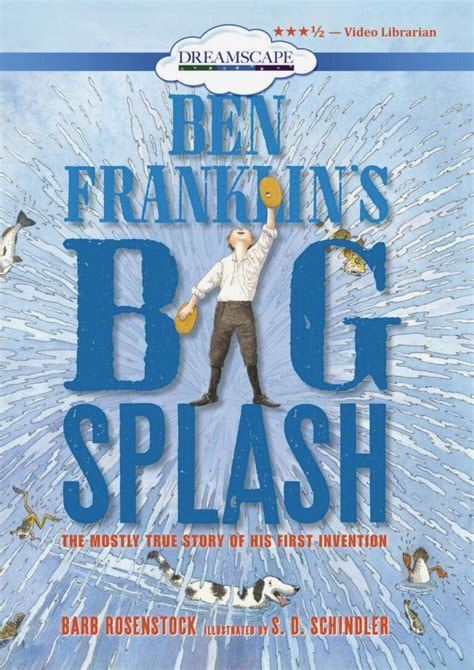
Title: Ben Franklin’s Big Splash
Author: Barb Rosenstock
Illustrator: S.D. Schindler
Year Published: 2021
Length: 32 pages
Before Thomas Edison and Henry Ford there was Benjamin Franklin, the most famous American inventor and scientist of the 18th century. His best known inventions include the lightning rod, bi-focal glasses, and the Franklin stove. Author Barb Rosenstock tells the story of Franklin’s first invention: swim fins.
This story is a great complement to The Inventor’s Secret as it emphasizes the same theme of persistence: “this smart, stubborn, sensible son of a soap-maker simply thought he’d made a mistake — and wouldn’t stop seeking, studying, and struggling until he SUCCEEDED.”
However, unlike Edison and Ford in The Inventor’s Secret, Rosenstock is telling the story of Franklin’s first invention, made when he was just a young boy. Children may find young Ben a more inspiring role model.
Young readers can engage with S.D. Schindler’s artwork by finding the animals on each page or counting the fish. Older readers might want to note how the author emphasizes specific words on each page. What do they have in common? “… where he SLID OFF his stinky shoes, STRIPPED OFF his sweaty stockings, SQUIRMED OUT of his sticky shirt, SHED his steamy breeches, and SPLASHED IN…” Also, ask them if they see where the text becomes part of the art.
time: 5 minutes
Therefore encourage one another and build one another up, just as in fact you are doing.
Thomas Edison was enormously encouraging to Henry Ford at a time when he needed it most. As an activity, ask your child(ren) to encourage a family member or friend at least once a day for the rest of the week (perhaps set up a checklist or star chart to mark each occasion). Work on developing the habit of encouraging one another, especially within your family. Ask your kids to memorize the scripture above as a reminder to work encouragement into their daily actions and their daily prayers.
time: 10 minutes
His contraption sputtered along for forty feet, then collapsed.
There are lots of great words in this story about inventing and innovating that may be new to your child(ren):
time: 10 minutes
Henry was curious about windup toys. He took his sister’s toys apart, but couldn’t always get them back together.
Starting on page 6, the illustrator, Jennifer Black Reinhardt, introduces an artistic motif on each page as a visual reminder as to whether the text is discussing Henry Ford or Thomas Edison. Can your kids pick out the motifs for each of them? The Henry Ford motif is especially large on pages 24, 25, and 27. See if they notice the blended motifs on the pages when Ford and Edison are together.
Once they’ve identified the motifs, ask them why is there a light bulb over Henry Ford’s head on page 31? And why are there different light bulbs on pages 34 and 35?
time: 10 minutes
Thomas’s phonograph is amazing!
The creative team of author and illustrator tells part of the story with illustrations showing what Edison and Ford are thinking – or dreaming. They use “thought bubbles” that look like clouds to showcase their thoughts with smaller clouds connecting the thought cloud to the character’s head.
In addition, the creative team also embeds some of the text in smoke from various sources. Ask your young readers if they can identify the thought bubbles (pages 10-11, 14-15, 21) and the smoke “bubbles” (pages 6-7, 12-13, 19, 22-23). Where is the smoke coming from?
Ask your child(ren) to draw a picture of a character/person. Then, ask them to draw a thought bubble and write or draw in what the character/person is thinking.
time: 10 minutes
Henry couldn’t stand it any longer. He had to find out Thomas’s secret!
There are two sequences of images featuring Henry Ford, the first on pages 24-25 and the second on page 27. This is a visual story-telling technique that can be used effectively to convey emotion or a series of actions occurring in a short period of time. Ask your kids to look at the images and describe what’s going on with Henry in each of the sequences. What is Henry feeling? What is he doing?
time: 10 minutes
He tied wires to his cats’ tails and rubbed their fur. Sparks flew that day!
Jennifer Black Reinhardt populates her drawings with a lot of fun animals, especially in the early pages. Ask your kids to find as many animals as they can. Look for an owl, fireflies, cats (lots of cats), baby ducks, cows, a donkey, chickens, a rabbit, robins, canary, horses, and a dog with its tongue out.
The horse on page 22 is quite expressive. What do you think it’s feeling? Scared? Shocked? Dismayed? Sad? Why?
time: 10 minutes
But the whole country was crazy about Thomas’s electric light. Henry scratched his head. What’s his secret?
This activity is a good one to pair with the “Meals by Candlelight” Re-enactment activity. Before turning off the lights for your candlelit dinner, ask your kids to go all around the house and count the number of light bulbs. You might need to point out to them some of the “hidden” lights in the stove, microwave, freezer and refrigerator. After this first counting, you can challenge them by showing them the different light bulbs on pages 34 and 35. Ask them to count how many different kinds of light bulbs there are in your home. Why are there different kinds of light bulbs?
time: 10 minutes
Most people thought his rattling gas buggy was a joke. “Get a horse!” people shouted at Henry.
Horsepower (hp) is a way of measuring power. Before steam and gasoline engines were invented, people traveled by riding horses or in coaches pulled by horses. Farm work was accomplished by hitching horses to farm equipment and having the horses pull it. When steam and gasoline engines began to replace horses for these tasks, the amount of power the engines generated was compared to how many horses it would take all yoked together to pull the load at the same speed as the engine.
Henry Ford’s Model T engine was rated at 20 hp. Today’s Honda Accord, with a turbo-charged 1.5 liter, 4-cylinder engine, is rated at almost ten times the Model T at 192 hp. How much power do you think a locomotive is rated at? (4,000 hp to 18,000 hp). How about a garage door opener? (½ to ¾ hp). Gas-powered lawn mower? (3-6 hp). Garbage disposal? (⅓ to 1 hp).