


In 1872, America took the unprecedented step of establishing the world’s first national park. President Ulysses S. Grant signed the legislation that protected the unique natural features of Yellowstone from exploitation, preserving them for future generations. President Teddy Roosevelt, after a camping trip with John Muir, drove legislation that created even more. We now have 63 national parks and our example encouraged other countries to establish their own national parks.
National parks are a legacy from one generation to the next. We protect and preserve them as part of our American heritage, to be handed on to future generations so they, in turn, can enjoy the beauty and wonder of God’s creation.
This generational generosity is part of America’s DNA, part of what makes us exceptional. Our example showed other countries what could be done and today national parks are standard in almost every country.
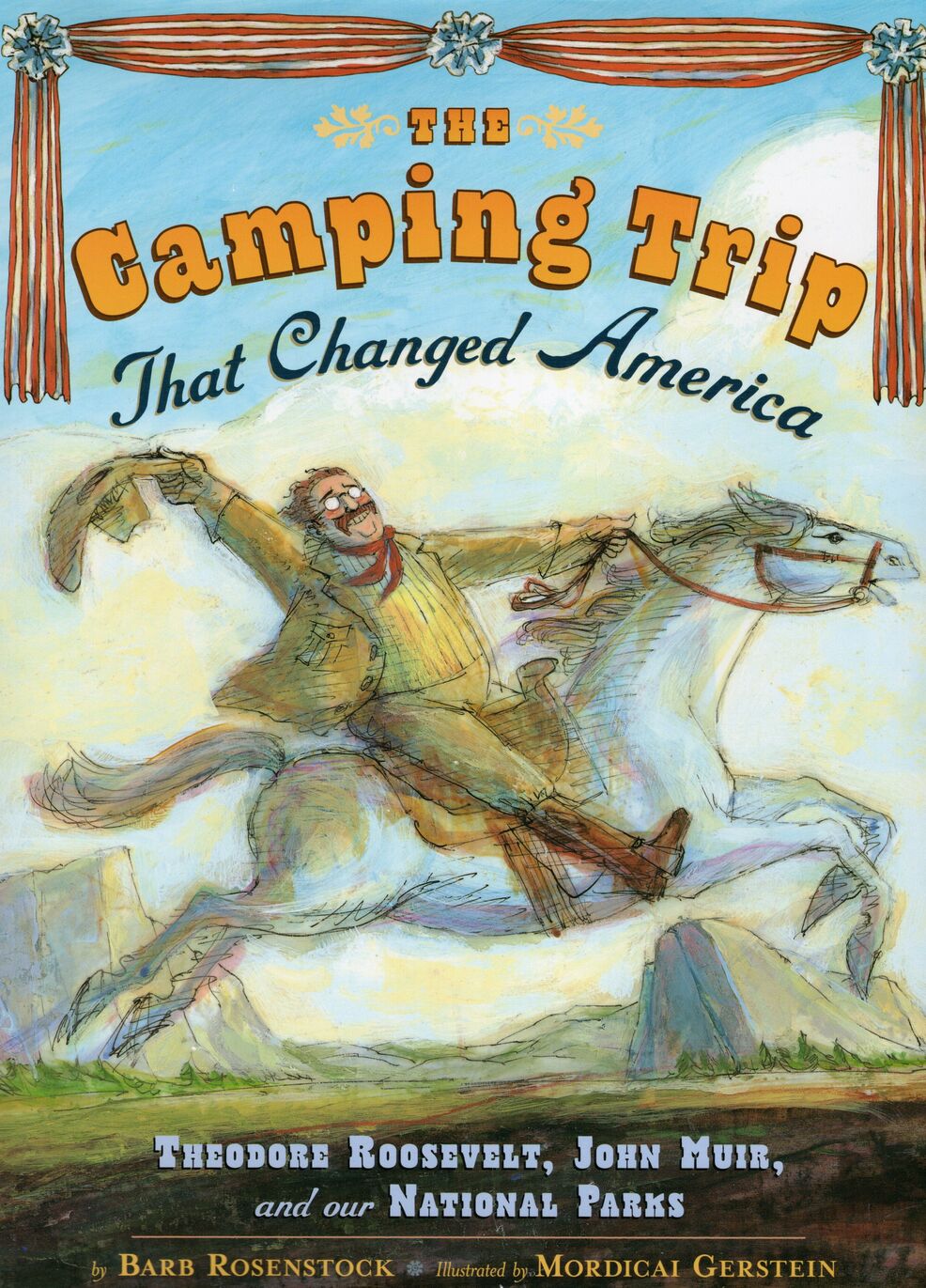
Title: The Camping Trip That Changed America
Author: Barb Rosenstock
Illustrator: Mordecai Gerstein
Year Published: 2012
Length: 32 pages
Below is one suggestion for your week with the book The Camping Trip That Changed America. Please experiment with what works for your family! (Note: not all activities are included in the suggested sample week below).
toc: "American Heritage Songbook: _This Is My Father's World_"
time: 5 minutes
freq: daily
This is my Father’s world, And to my listening ears All nature sings, and round me rings The music of the spheres.
This is my Father’s world: I rest me in the thought Of rocks and trees, of skies and seas; His hand the wonders wrought.
This hymn celebrates the joy we find in God’s creation: “of rocks and trees, of skies and seas.” It places the listener in the center of that creation, quietly listening and communing with His creation: “in the rustling grass I hear Him pass; He speaks to me everywhere.” Written by Presbyterian minister Maltbie Babcock, the poem was published posthumously by his wife in 1901 and set to music in 1915 by Franklin Sheppard, Babcock’s friend.
An instrumental version of the hymn was included in Ken Burns’ 2009 documentary The National Parks: America’s Best Idea. While the version on the documentary is not available, you can listen to this instrumental version; Amy Grant sings this version, which includes the lyrics on screen. Finally, with this version, you can turn the lyrics on and off with the “closed caption” button on the bottom.
time: 15-30 minutes
prep: 5 minutes
supplies: construction paper, pencil, scissors, glue stick
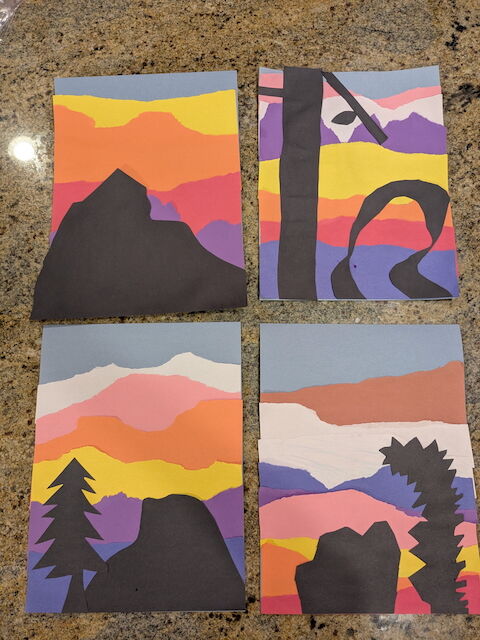
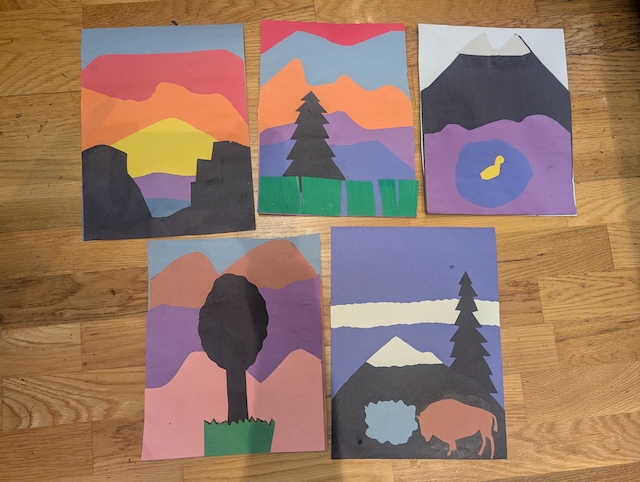
On horseback, Muir and Roosevelt rode down into the famous Yosemite Valley. The granite formations towered above them. They passed the sheared cliff of Half Dome and the fierce face of El Capitan rising from the valley floor.
Inspired by Imaginative Homeschool!
time: 15-20 minutes
supplies:
“Glaciers carved this whole valley,” said Johnnie, spreading his arms. He lay down on a slab of granite and inched along on his back to show how a massive river of slow-moving ice carved the rock beneath them millions of years before.
There are currently 63 national parks designated across the country and in territories controlled by the United States (American Samoa and U.S. Virgin Islands each have one). They are not distributed equally amongst the states. Take a look at this Wikipedia interactive map showing our national parks. Ask your kids some of the following questions:
You can find a free printable checklist of our national parks here. Ask your kids to check off any national parks they have visited. Share with them the list of national parks that you have visited. Tell them about your favorites or perhaps the first national park you visited that you remember. To make this more tangible for your kids, assemble a jigsaw puzzle of all the states where you have visited a national park.
time: 5 minutes
freq: once
Teedie and Johnnie never spent any time together again. Teedie traveled the world but called the night of the snowstorm “the one day of my life that I will always remember with pleasure.” Johnnie felt the same.
President Teddy Roosevelt was already an ardent preservationist before his camping trip with John Muir. In 1902 he had signed legislation establishing Crater Lake as our nation’s fifth national park and in 1903 Wind Cave became the sixth. After the camping trip he signed legislation for an additional three, more than doubling the number of our national parks during his presidency. Under the Antiquities Act, landmark legislation passed in 1906, he would establish 18 national monuments (three of which would later be upgraded to national parks, including the Grand Canyon) and 150 national forests. In his 1905 book, Outdoor Pastimes of An American Hunter, he wrote:
There can be nothing in the world more beautiful than Yosemite, the groves of the giant sequoias and redwoods, the Canyon of the Colorado, the Canyon of the Yellowstone, the Three Tetons; and our people should see to it that they are preserved for their children and their children’s children forever, with their majestic beauty all unmarred.
John Muir wrote often about the wilderness, inspiring many (including President Roosevelt) to visit and help preserve it. In his 1911 book, My First Summer in the Sierra, he connected the wilderness to the divine:
Oh, these vast, calm, measureless mountain days, inciting at once to work and rest! Days in whose light everything seems equally divine, opening a thousand windows to show us God.
Watch this short video biography (five minutes) of John Muir to learn more about him and why he is sometimes called the “Father of the National Parks.”
time: 10-20 minutes
prep: 5-10 minutes
supplies: graham crackers, chocolate, marshmallows
They camped high above the valley floor. Johnnie made the president a bed of branches and they settled near the fire for warmth.
S’mores are the classic camping dessert made over a fire. But you can make them at home without a fire as well! Be sure to have wipes handy as this will get sticky.
time: 20-30 minutes
prep: 10-15 minutes
supplies: plastic cup, jar, oil, Alka-Seltzer tablets, white paint or food coloring, shaving cream, spoons
Overnight a storm blew in, spreading five inches of fresh snow. Teedie and Johnnie woke under a coverlet of white flakes. They shook themselves off like two old grizzly bears.
You can make both a snowstorm in a jar and a rain cloud in a jar. Enjoy making some contained weather (based on onelittleproject).
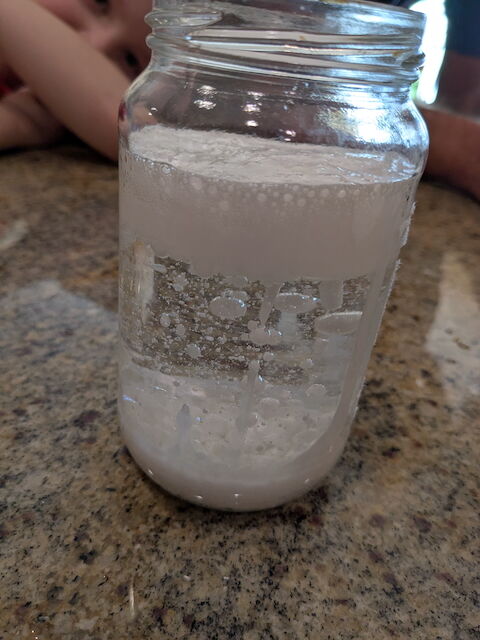
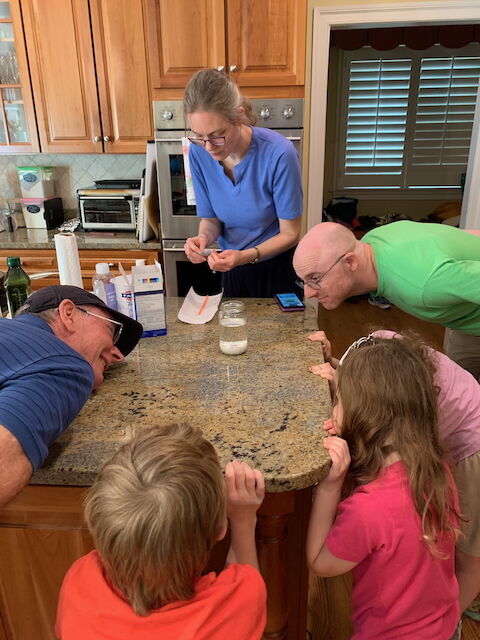
Science discussion: This isn’t how snowstorms actually work, but it’s a fun experiment and there’s some interesting science nonetheless. The white-painted water stays separate from the baby oil because oil and water are immiscible (they don’t mix: water’s polarized molecules prefer to be closer to other polarized water molecules, while oil’s non-polarized molecules also prefer their own company, so a clear boundary develops between the two substances). On the other hand, water-based paint does readily mix with water, coloring it white. The water (and paint) is heavier than the oil, so it will naturally form a separate layer at the bottom of the jar.
The snowstorm starts when the alka-seltzer tablets release carbon dioxide into the water. The gas is much lighter than both the water and the oil, so it travels up to the water-oil boundary. At this point, rather than simply passing directly into the oil, the surface tension of the water kicks in: the bonds between nearby water molecules are so strong that the air bubble can’t immediately break through them to get into the oil. Instead, the paint and water forms a small additional bubble around the air bubble as it travels up through the oil layer (with the CO₂ inside, the water bubble is now lighter than the oil). Once it finally reaches the top of the oil layer, the gas escapes into the atmosphere, and what’s left is a ball of water and paint that’s again heavier than the oil around it, so it sinks back down through the oil like snow. This repeats until the alka-seltzer tablet is gone.
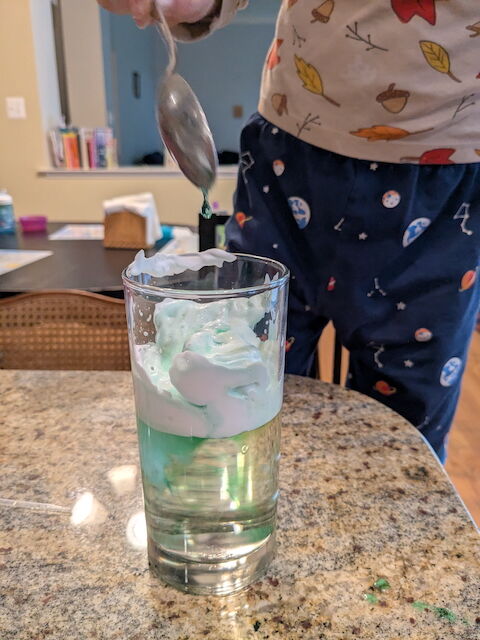
Science discussion: While it’s not exactly the same as clouds (which themselves are just water), the foam is also able to support a certain amount of water without it falling through. Once you reach that limit, the extra colored water falls out of the cloud into the clear water. Since the food coloring slightly increases the weight of the water around it, the rain drop initially starts travelling down through the slightly lighter clear water, but mixing equalizes the densities pretty quickly. This experiment can be a bit finnicky, particularly with respect to the ratio of water to food coloring. We found that if there’s too little food coloring, then the trace amounts of dissolved foam actually cause the colored water to be lighter than the clear water, so it just floats at the top, which is less impressive. For an interesting follow-up experiment, try using baby oil or mineral oil in the bottom layer and see if you can guess what will change.
time: 20-30 minutes
prep: 10 minutes
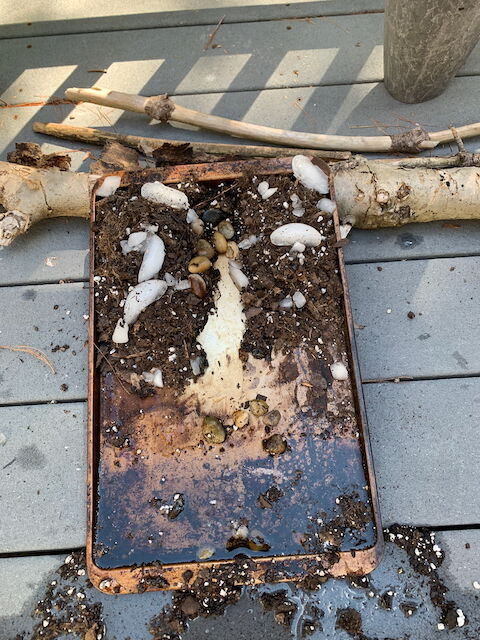
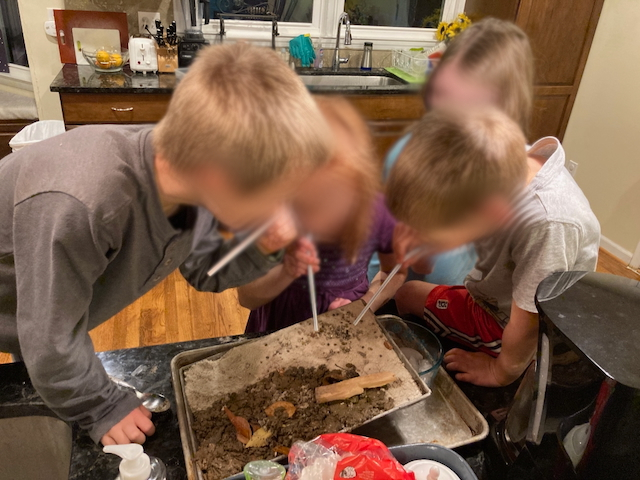
supplies: baking sheet, dirt, rocks, water, pitcher, straw, ice
… Glaciers carved rivers and created plains.
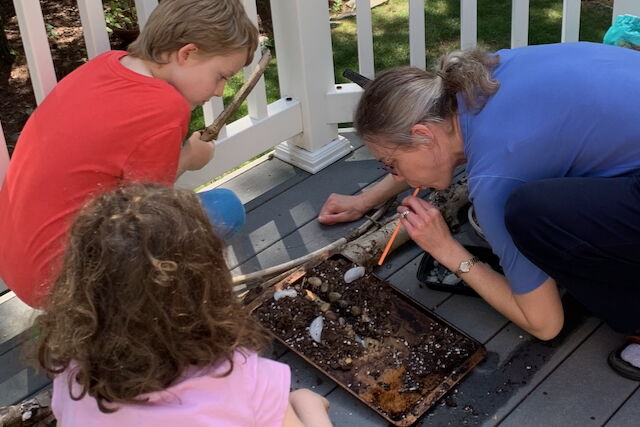
Natural forces shaped the unique geography found in many National Parks: Glaciers (Yosemite, Glacier NP), Volcanoes (Yellowstone, Hawaii), Rivers (Grand Canyon, Zion), Tectonic Plates (Rocky Mountains, Sierras), Erosion (Bryce Canyon, Arches NP). Many of these forces can be considered types of erosion such as wind, water, and glaciers. It can help to see how erosion works on a smaller scale (both in terms of size and time) and so making a model can be helpful (and fun!). Directions are below but you can also watch this short Youtube video.
toc: "Re-enactment: Camping Trip"
time: weekend
prep: 20-30 minutes
supplies: s'mores, camping equipment
When he found men sending his baggage to the best hotel in town, Roosevelt shouted, “By George, I’m going camping! Pack me one small sack!”
Ideally, for this re-enactment, you would pack up the family and drive to the nearest national park. However, state parks are more numerous and usually closer, so they can be an excellent alternative. State parks can be as stunning as national parks (for example, Niagara Falls is a state park in New York). Another possible option is camping out in the backyard.
To enjoy the full “Teedie and Johnny” experience, you will need a campfire to tell stories around. But, you will not need a tent – just sleeping bags out under the stars! Or you can even simulate the outdoors inside the house by piling up some pillows, putting a flashlight in the middle to create a “fire” and then turning on a star projector.
And, while s’mores were not invented until the 1920s, we’re sure that Teedie and Johnny would approve of adding this campfire confection to your camping experience. (Use the “S’mores from the oven” directions for your indoor camping trip).
If there is a fourth grader in your family, you can take advantage of the National Park Service’s Every Kid Outdoors Program. This program provides free access to all public lands, including National Parks, for one year for all fourth graders PLUS other children in the family under the age of 16 and up to three adults. And yes, this program explicitly welcomes homeschool families: “I’m in the fourth grade or home-school equivalent.”
time: 15 minutes
In 1995, ten adult wolves were brought down from Canada and set free in Yellowstone National Park. They dug dens and bore puppies.
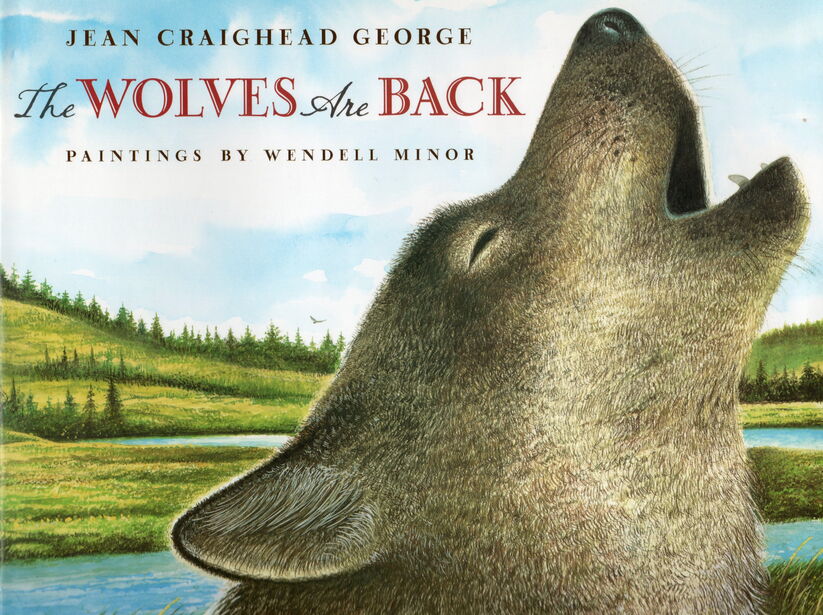
Title: The Wolves Are Back
Author: Jean Craigshead George
Illustrator: Wendell Minor
Year Published: 2008
Length: 32 pages
This story features Yellowstone, the first national park in America (and the world). It is a true story of how wolves were eliminated throughout the United States (with the exception of Alaska) in the 1920s. The story demonstrates the unintended consequences of eliminating an apex predator and the downstream damage it can cause due to the interconnectedness of a food chain. As the quoted text notes, wolves were re-introduced in 1995, resulting in a complete re-balancing of the park’s eco-system.
Wendell Minor’s illustrations of the huge variety of animals and flowers in Yellowstone are wonderful to behold. Ask your kids to pick one of their favorite pages and try drawing it.
For older kids, ask them to write down the name of every animal that is mentioned in the story. Next, cut them out so every name is on a separate piece of paper. Finally, arrange them in a “food chain” starting with the wolf at the top. Which animal eats which? (This activity led to a passionate discussion amongst one family, especially when it came to Grizzly Bears. They eventually agreed that wolves do not attack healthy Grizzly Bears but will happily hunt down bear cubs.)
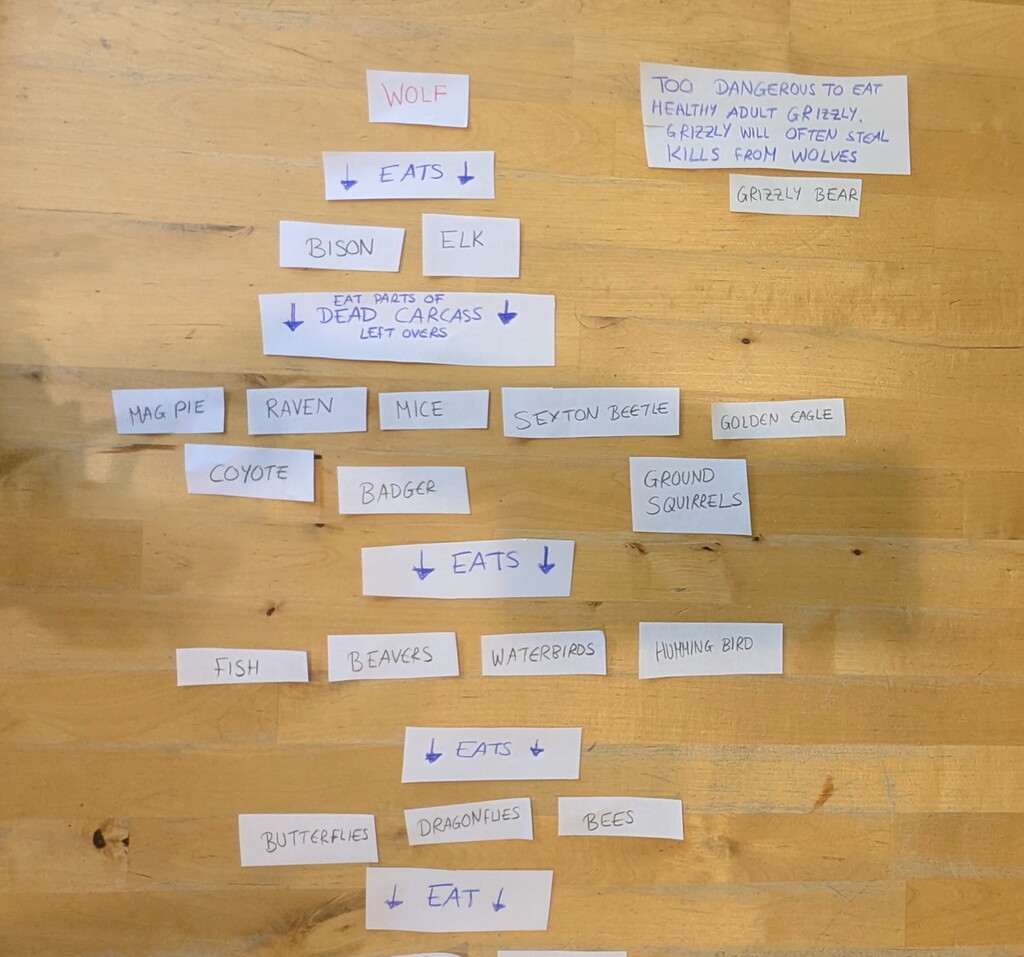
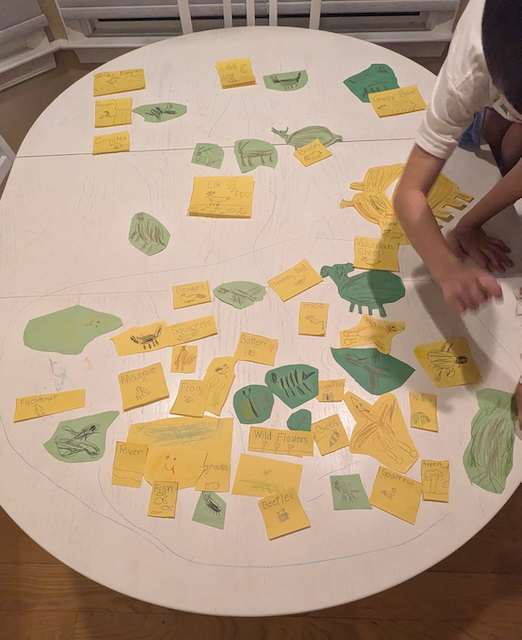
Two different approaches to making a food chain
time: 10 minutes
freq: daily
He makes me lie down in green pastures, he leads me beside quiet waters, he restores my soul.
This portion of Psalm 23 evokes the serenity that flows from the Lord as He rejuvenates us within His creation. Johnnie and Teedie could certainly understand this serenity as they hiked and camped in Yosemite.
Ask your children to memorize this scripture by writing it down five times each day. You may want to get them a “copybook” for writing down scripture and phrases worthy of memorization. This can be good practice for handwriting as well.
time: 10 minutes
That night, under the branches of a towering sequoia called the Grizzly Giant, Teedie lay on the forty thick wool blankets his men prepared.
The vocabulary words for this module are mostly about some of the natural wonders in Yosemite and how they were created: wilderness, sequoia, glacier, valley, granite, sculpted, sheared. Understanding these words will help young readers comprehend John Muir’s description of how glaciers created Yosemite.
time: 10-20 minutes
Johnnie began his story, “This whole continent is a great garden…”
Ask your kids to write a one-paragraph, ten-sentence story about the National Parks and/or nature, using these writing prompts (from Brian Tolentino Writing Prompts):
Sentence 1: Write a vivid description of a setting using only SEVEN words.
Sentence 2: Include ONE of these emotions: Elation, Dread, Curiosity, Frustration, Awe, Guilt
Sentence 3: Use ONE of these nouns: Bridge, Whisper, Treasure, Storm, Shadow.
Sentence 4: Write a sentence with exactly FOUR words.
Sentence 5: Begin with “Suddenly,” and use a sensory detail ( Sight, sound, touch, smell, etc.)
Sentence 6 and 7: Include a simile in one sentence and a metaphor in the other.
Sentence 8: Start with “Why” and make it a question
Sentence 9 and 10: Use a cliffhanger ending that leaves the reader wanting more.
Here’s an example from one young writer: 1) Green trees soar in the national park. 2) I was in awe when I saw the crisp gold leaves on the trees. 3) I saw the shadow of a majestic Grizzly Bear. 4) My hands trembled slightly. 5) Suddenly, I saw the bear close behind me. 6) The bear smelled like dirty socks. 7) The knot in my stomach grew tighter as the bear got closer. 8) Why did I not get bear repellant? 9/10) When it got really close I decided to run. And then the bear jumped at me…
time: 10-20 minutes
He told Teedie the funny story of meeting his first bear.
There are three double-page spreads in the story that show Muir telling Roosevelt a story by a campfire. The smoke from the fire becomes the thought bubbles above their heads depicting what Muir is describing. The thought bubbles show the story within the story and convey what Muir is expressing to Roosevelt while also showing what is actually happening in the foreground. These spreads take advantage of two different techniques: thought bubbles and the use of steam or smoke to give a dreamy quality.
Have your child(ren) try out this technique of showing what characters are saying by using smoke thought bubbles in their own picture (or larger story). Consider incorporating this technique in your guided writing activity.
time: 10-20 minutes
Teedie left Johnnie in Yosemite and headed back home. His time in the forest turned the outdoor-loving president into one of nature’s fiercest protectors.
Congress created the National Park Service in 1916. Its mission statement reads:
The National Park Service is dedicated to conserving unimpaired the natural and cultural resources and values of the National Park System for the enjoyment, education, and inspiration of this and future generations. The Service is also responsible for managing a great variety of national and international programs designed to help extend the benefits of natural and cultural resource conservation and outdoor recreation throughout this country and the world.
Take a look at the National Park Service’s logo to see how its symbolism reflects their mission statement.
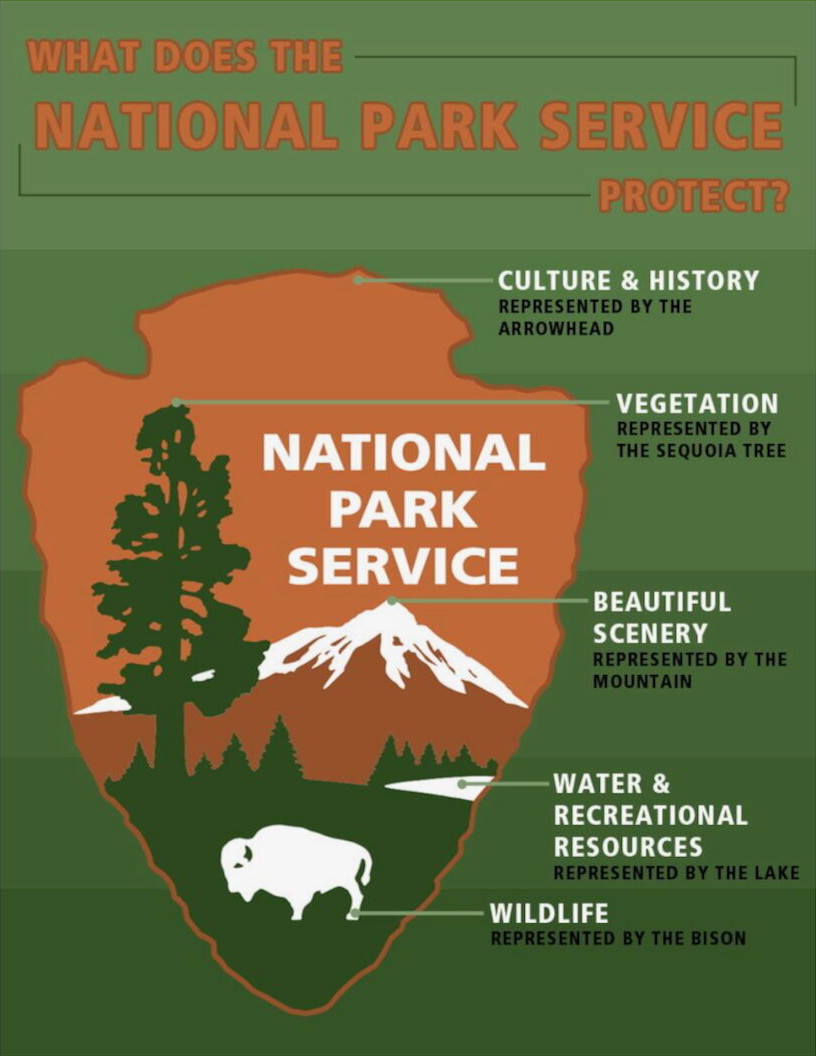
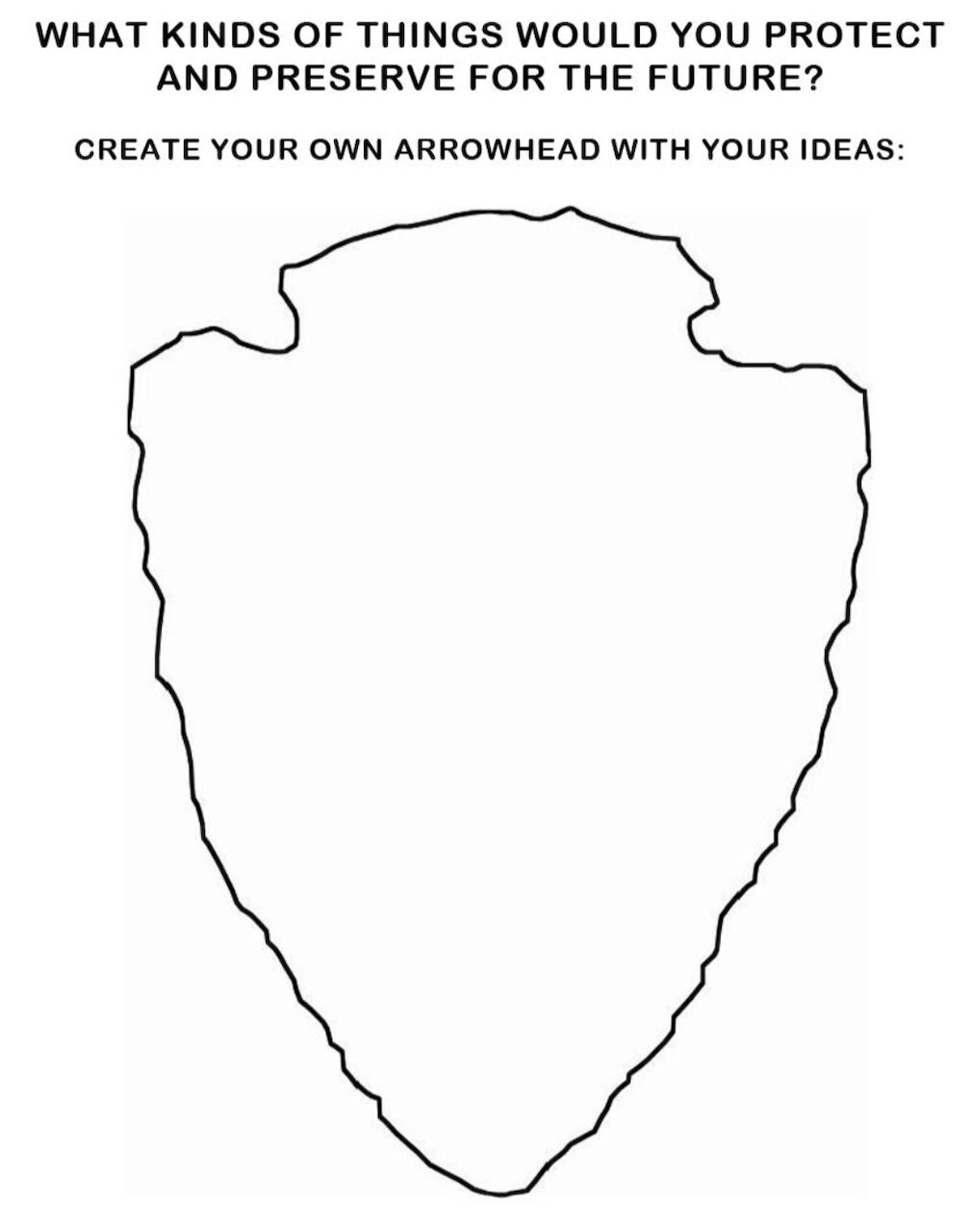
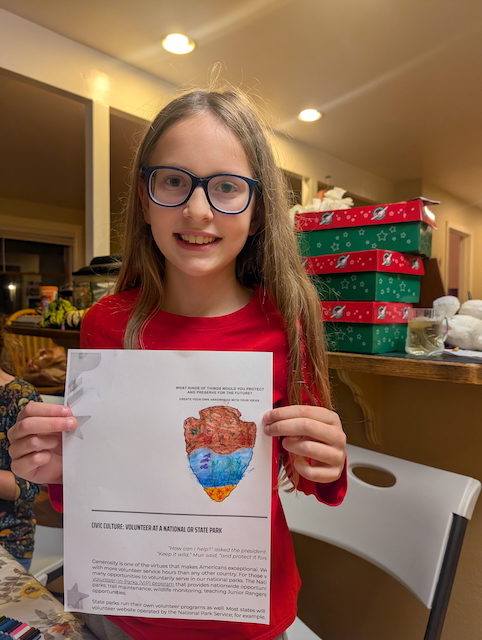
Now, using the template below, make your own logo, identifying what you would protect and preserve.
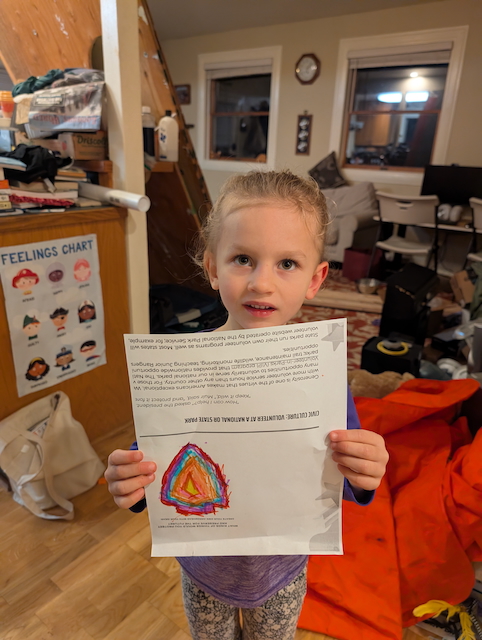
time: one day
“How can I help?” asked the president. “Keep it wild,” Muir said, “and protect it forever.”
Generosity is one of the virtues that makes Americans exceptional. We donate our time generously with more volunteer service hours than any other country. For those who like the outdoors, there are many opportunities to voluntarily serve in our national parks. The National Park Service runs a Volunteer-In-Parks (VIP) program that provides nationwide opportunities to work in our national parks; trail maintenance, wildlife monitoring, teaching Junior Rangers are just a few of the volunteer opportunities.
State parks run their own volunteer programs as well. Most states will have something similar to the volunteer website operated by the National Park Service; for example, here are websites for Virginia, Texas, and Florida.
For this activity, find a one day volunteer activity at either a national park or a state park that the whole family can do together. In addition, consider taking part in the Junior Ranger program sponsored by the National Park Service.
time: 15 minutes
When he looked up, he couldn’t see the treetops. The sequoias soared straight to the heavens. “These trees grew up when the Egyptians built the pyramids,” said Johnnie. “They are the largest living things on earth.”
It is hard to get a sense of how big Giant Sequoias are (or Yosemite’s famous granite walls) without seeing them in person. Measuring out actual sizes or finding things to compare them to (for example, El Capitan is about as tall as three Eiffel Towers) can help.
Giant Sequoias
Take a look at this National Park website that ranks the top 50 biggest Sequoias. Can you find the two located in Yosemite National Park?
Half Dome Height: About 5,000 ft above the valley or 8,800 ft above sea level. Watch this National Park Service video for some perspective on one of the most iconic and challenging hikes in our National Park System.
El Capitan Height: About 3,000 ft above the valley