


America’s Apollo 11 mission changed human history forever by landing two men on the moon. Our space program captured the attention of the entire world on July 20, 1969. It was the culmination of years of dedicated work by thousands of people striving towards the same goal. New technologies, new industries, and new government agencies were born of the effort.
Few endeavors are more emblematic of American Exceptionalism than the Apollo program. The work ethic, the aspirations, the entrepreneurial drive to open up a new frontier are all essential elements of our exceptionalism. Our space program harnessed the power of our free enterprise system for this historic achievement.
The Bald Eagle is our National Bird, and its image symbolizes American strength, dignity, determination, and faithfulness. The Bald Eagle was initially incorporated into our National Seal. From there, the iconic eagle spread to our coinage, becoming an important symbol of America. Apollo 11 took that symbol to new heights.
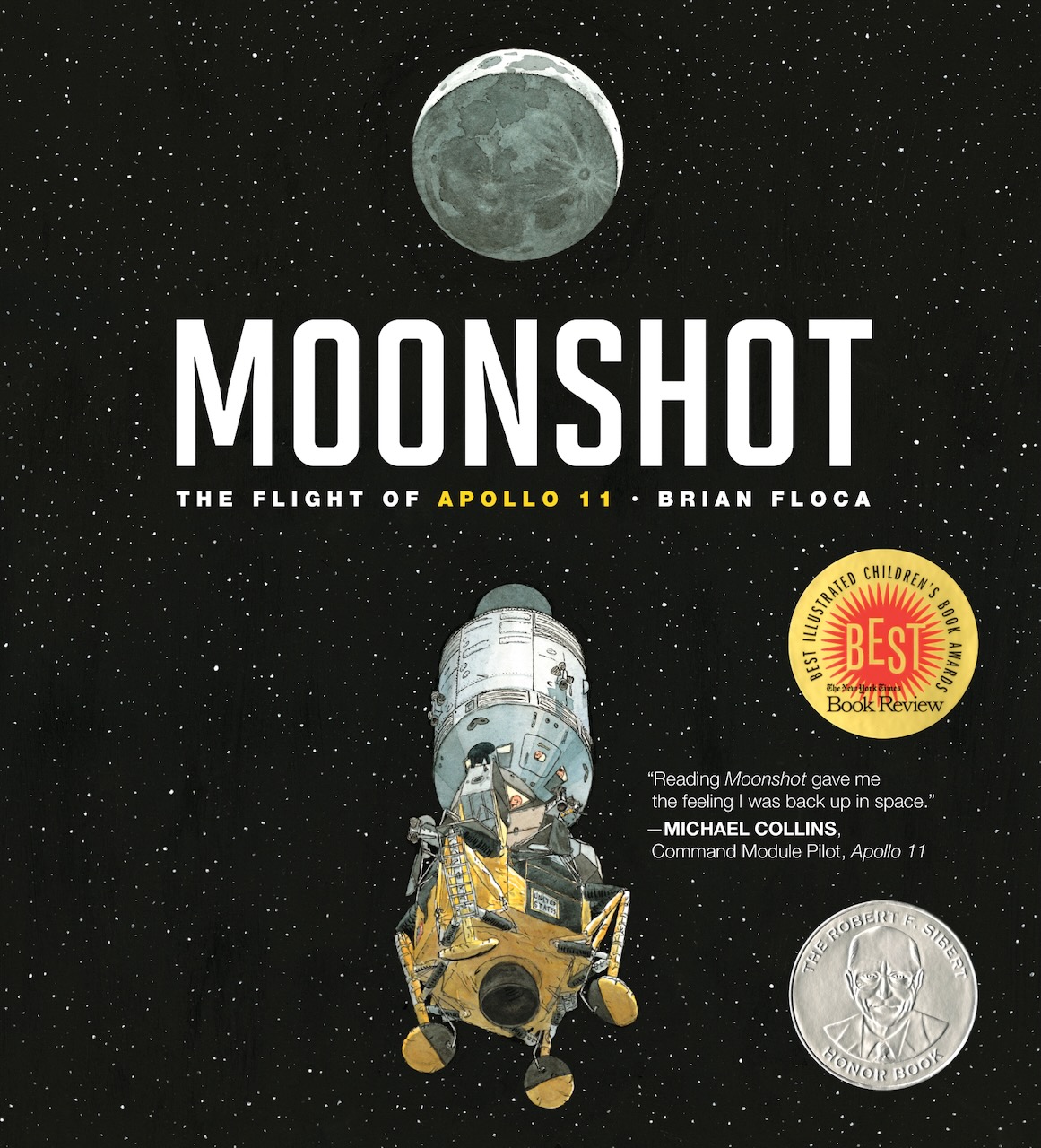
Title: Moonshot: The Flight of Apollo 11
Author: Brian Floca
Illustrator: Brian Floca
Year Published: 2019
Length: 56 pages
Below is one suggestion for your week with the book Moonshot. Please experiment with what works for your family! (Note: not all activities are included in the suggested sample week below).
toc: "American Heritage Songbook: _It's America_"
time: 5 minutes
freq: daily
It’s a man on the moon and fireflies in June and kids sellin’ lemonade It’s cities and farms, it’s open arms, one nation under God It’s America
Country singer Rodney Atkins captures much of the spirit of America in this song. Released in 2008, it reached #1 on the country charts in 2009. “Kids sellin’ lemonade’’ is not only part of the chorus but a recurring visual motif in Atkins’ music video of the song.
The lemonade stand starts off as symbolic of America’s entrepreneurial culture. But in the music video, as we move into the second stanza, the lemonade stand changes into a tornado relief fundraising station that represents how we as a nation come together in Tocqueville’s voluntary associations to help one another.
And people came from miles around just to help their neighbors out And I was thinking to myself I’m so glad that I live in America
In the final stanza of the song and video, the lemonade stand is now part of a “welcome home parade” for a soldier returning home. Atkins acknowledges our imperfections on the bridge of the song before concluding:
Now we might not always get it all right There’s no place else I’d rather build my life
Here’s an alternate video of the song with different images of America.
time: 15 minutes
prep: minimal
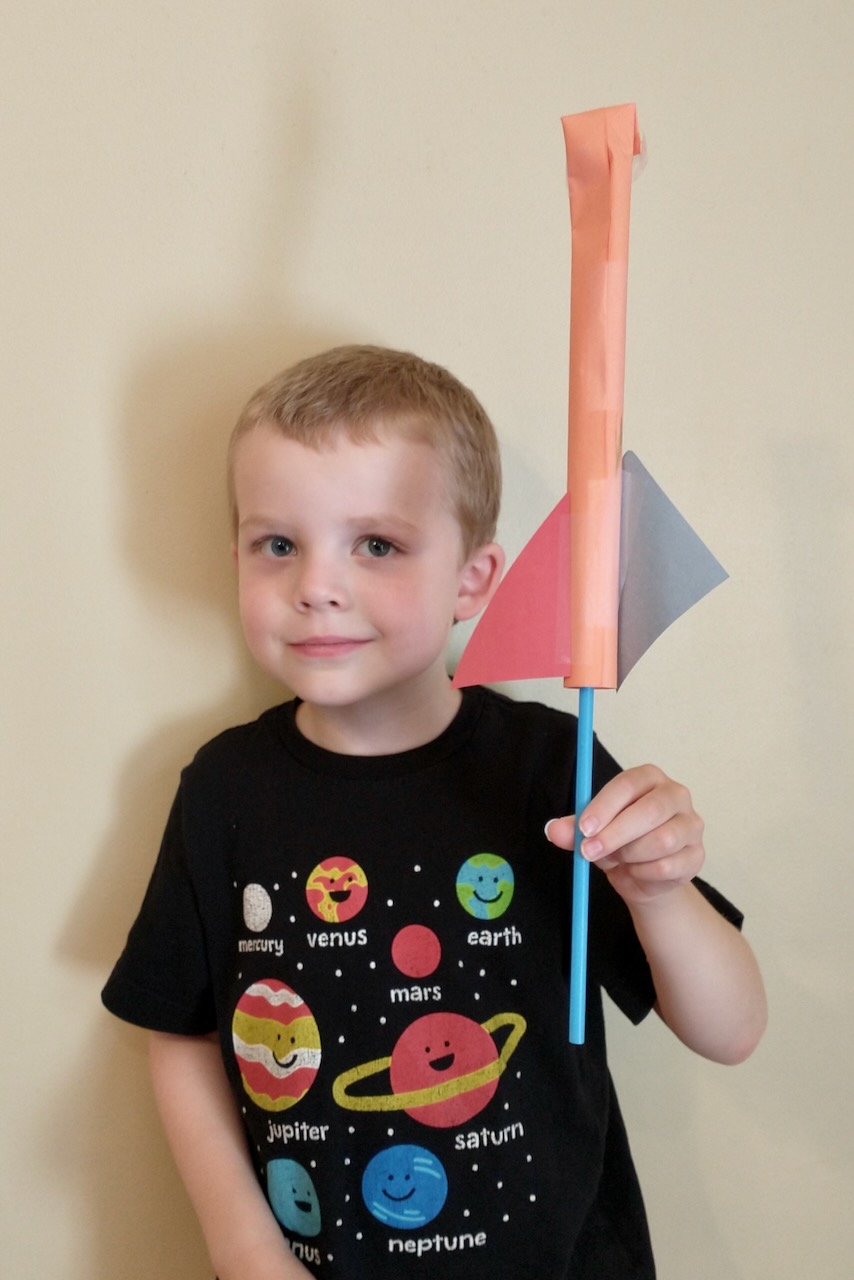
supplies: straws, construction paper, tape, scissors
LIFTOFF! The rocket is released! It rises foot by foot, It rises pound by pound.
Using a few common craft supplies, you can make your own straw-based rocket, powered by your own breath! Here is what you need:
The above is based on the instructions from the website AllForTheBoys. You can find instructions for a slightly more complicated design at NASA’s JPL site.
time: 10 minutes
supplies: globe
It is summer here in Florida, Hot, and near the sea.
Near the rocket, in Launch Control, and far away in Houston, in Mission Control, there are numbers, screens, charts, ways of watching and checking every system and part of Apollo 11, the fuel, the valves, the pipes, the engines, the beats of the astronauts’ hearts.
This geography lesson should start by getting out your globe and showing your kids where the Kennedy Space Center is located on Cape Canaveral in Florida. The first question to ask your kids is: “Why do you think they chose a location on the coast of Florida?” With a few hints, they should be able to get the first part of the answer: in case there is a problem after it launches, the rockets will crash in the ocean where there it is less likely they will injure people. Similarly, it was a largely undeveloped area at the time but with good roads because of military bases. Again, very few people in the area in case of accidents or explosions at the launch site.
The other parts of the answer have to do with the rotation of the earth. If you look down on the earth from the North Pole, the earth is spinning in a counterclockwise direction. Ask your kids to spin your globe slowly to illustrate this. Then, show them how Cape Canaveral is located on the east side of Florida and how rocket launches are always aimed over the Atlantic Ocean. Show them how this enables the rockets to take advantage of the angular momentum provided by the rotation of the earth when they launch (this is rocket science!).
Moreover, the closer the launch site is to the equator, the greater the angular momentum. For the United States, this meant the Kennedy Space Center should be located in a southern state. While Hawaii is the southernmost state, its remote location meant it was not seriously considered. Florida is the southernmost state in the continental United States.
Now, show your kids on the globe where Mission Control is located in Houston, Texas. Then ask them: “Why is Mission Control located so far away from where the rockets are launched?” Well, there is no practical reason why Mission Control must be located at the same site where the rockets are launched. And because exploring space was largely a government funded program, politics became a big factor in deciding which state would reap the benefits of hosting Mission Control. Mission Control is now located in Houston at the Johnson Space Center, named after President Lyndon Baines Johnson, who was from Texas and was intimately involved in establishing the space program, first as vice-president (1961-1963), and then president (1963-1968).
time: 5 minutes
freq: once
We choose to go to the moon.
In 1961 the United States was losing the space race to the Russians. Russians were first to launch a satellite (Sputnik in 1957), they were first to launch a space probe to hit the moon (Luna 2 in 1959), and they were first to launch a man into space (Yuri Gagarin in April of 1961).
In May of 1961, President John F. Kennedy put forth a bold goal for the United States: to land a man on the moon “before this decade is out.” He rallied America for the effort in a speech at Rice University in September of the following year. Known as the “We choose to go to the moon” speech, you can see two minutes of the highlights on YouTube. Here is the key paragraph:
We choose to go to the Moon. We choose to go to the Moon in this decade and do the other things, not because they are easy, but because they are hard, because that goal will serve to organize and measure the best of our energies and skills, because that challenge is one that we are willing to accept, one we are unwilling to postpone, and one which we intend to win, and the others, too.
On July 20, 1969, Neil Armstrong and Buzz Aldrin fulfilled Kennedy’s bold goal by landing their lunar module, the Eagle, on the moon. Neil Armstrong uttered two famous sentences that have echoed down to us. The first was upon touchdown on the moon: The Eagle has landed.
The second was when he became the first man to set foot on the moon: That’s one small step for [a] man; one giant leap for mankind.
Ask your kids to memorize one of Armstrong’s famous sentences or the single sentence of Kennedy’s speech: “We choose to go to the moon.”
While we started out behind in the space race, we quickly caught up. It’s been over 50 years since the last Americans walked on the moon (Apollo 17, December 1972). In all that time, no other nation has ever sent anyone to the moon.
time: 20 minutes
prep: 10-15 minutes
supplies: butter, sugar, eggs, yogurt, lemon, flour, vanilla, baking powder, baking soda, salt
Here, where everything floats, it takes some skill to eat a meal. That ham salad sandwich? Watch the crumbs! Soup? It comes in a bag, dry as dust.
You too can eat like an astronaut with this simple three ingredient astronaut pudding, courtesy of FeelsLikeHomeBlog.com. Check out their entry on astronaut pudding, there are some great videos embedded in it. Or go straight to the recipe below:
time: 30-60 minutes
prep: 20-30 minutes
supplies: plastic bottle, straws, duct tape, cardboard, cork, baking soda, vinegar, paper towels, scissors
It climbs the summer sky. It rides a flapping, cracking flame and shakes the air, and shakes the earth, and makes a mighty ROAR.
This three-minute video from STEM Little Explorers will show you how to build your own baking soda and vinegar powered rocket. We used a very small bottle when we did this which meant it didn’t take long for the gas to build up, but also meant that it didn’t fly very high (I’d recommend something larger along the lines of 1.5 liters minimum). We had a little bit of difficulty getting our straws to hold up the rocket while awaiting launch. Something with a little more weight may fare better. Lots to experiment with here!
And of course, after you make your first successful launch, you can call yourself a rocket scientist!
toc: "Re-enactment: More Rockets!"
time: 20-60 minutes
prep: 5-10 minutes
supplies: water-powered rocket
The rocket flies higher, The rocket flies faster, in twelve minutes’ time, it’s one hundred miles high.
After watching Apollo 11 lift-off, who doesn’t want to launch their own rocket? There are a number of different types of rockets that you can launch yourself, including the breath-powered rocket in the Arts & Crafts activity and the gas-powered rocket in the Science activity. Estes model rockets are also a possibility. They have a real engine that ignites and they fly higher and farther. However, they are expensive, are more suitable for older children/adults and some counties have regulations regarding their use. (But they are very cool and kids love chasing them down when they land).
For the historical re-enactment we used both the baking soda and vinegar rocket described in Science, but also a water-powered rocket that we purchased. However, it is possible to make a water-powered rocket as well.
Here is a link to the water powered rocket that we bought (but there are many options available). In addition to the kit, you need 3 1.5-2 liter bottles and water to anchor it. This kit was easy to put together and worked well (that is, until after some crash landings). We played around with angle, number of pumps of air, and amount of water. We got some good launches (20+ feet in the air). The kit enabled a countdown to release the rocket after the air and water were inside the rocket. I also liked the clean fuel it used. This was very cool! We needed a large outdoor space for the launch and so naturally attracted a number of neighborhood kids to watch.
time: 10 minutes
With only seconds of fuel remaining, Neil safely lowered the hovering spacecraft to the moon’s surface.
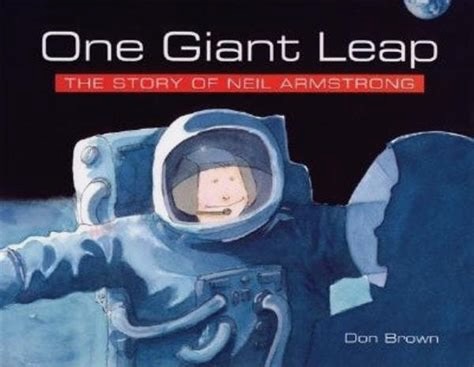
Title: One Giant Leap: The Story of Neil Armstrong
Author: Don Brown
Illustrator: Don Brown
Year Published: 2001
Length: 32 pages
Don Brown’s One Giant Leap provides the inspirational biography of Neil Armstrong, the first man to set foot on the moon. This book is an excellent supplemental reading to Brian Floca’s Moonshot!, providing a deeper background on how the boy with dreams of flying turned into an astronaut commanding Apollo 11. Your kids will learn how Armstrong realized his dreams by working hard to buy flying lessons, earning his pilot’s license when he turned 16 (before he got his driver’s license!). Before joining the space program, he was a Navy fighter pilot during the Korean War and a test pilot for rocket-powered airplanes.
Brown starts and ends his story by focusing on a young boy’s dreams. We recommend reading this story as a supplemental reading sometime in the middle of the module as either a replacement for the daily reading of Moonshot! or in addition to it.
time: 5 minutes
… but those who hope in the LORD will renew their strength. They will soar on wings like eagles; they will run and not grow weary; they will walk and not be faint.
This inspirational scripture from the Old Testament ties in nicely with the “eagles” theme of this module. Consider having your kids memorize it as part of their daily prayers.
time: 10 minutes
Armstrong, calling from the Moon, calm as a man who just parked a car. “Houston,” he says. “Tranquility Base here. The Eagle has landed.”
This module’s vocabulary words introduce young audiences to the exploration of space and rocket science. Some terms are self-explanatory, and many may be picked up from the context and pictures.
time: 93 minutes
Their two small spaceships are Columbia and Eagle. They are locked to the top of the rocket that will lift them into space, a monster of a machine… the mighty, massive Saturn V.
There are many documentaries about Apollo 11 but one of the best came out in 2019 on the 50th anniversary of when we first landed on the moon. You can watch it online here for a small fee. It includes fantastic footage and audio of the event and is highly recommended.
Your kids might also be interested in the computer-generated imagery of the Eagle landing and taking off from the moon. The first of these extremely short videos (57 seconds) shows Eagle undocking from Columbia (the command module). The next shows Eagle landing on the moon (1:40). And the last (38 seconds) shows Eagle taking off from the moon to rejoin Columbia.
time: 10-15 minutes
The Eagle has landed.
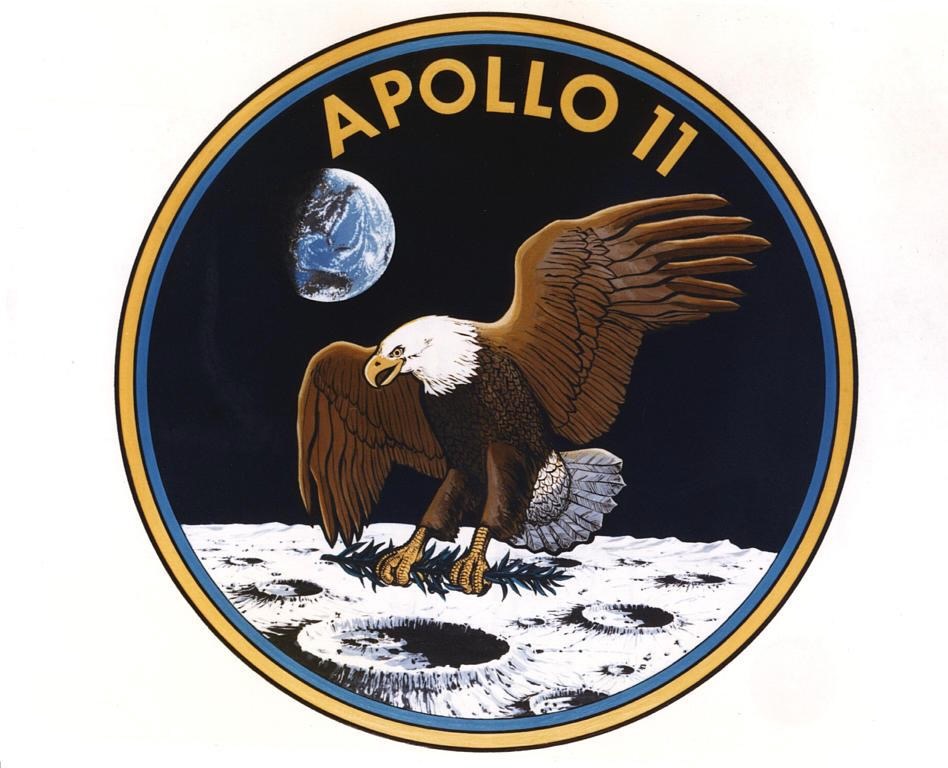
Apollo astronauts got to design their own mission patch. With the exception of Apollo 11, all the other Apollo mission patches included the names of the three astronauts. Neil Armstrong, Buzz Aldrin, and Michael Collins, the three Apollo 11 astronauts wanted their patch to symbolize the work of the entire space program in putting the first men on the moon. Astronaut Jim Lovell (commander of Apollo 8 and Apollo 13) suggested the eagle, but it was Michael Collins who drew the initial sketch that was developed into the patch.

Why did Lovell suggest a bald eagle? Because the bald eagle was adopted by Congress in 1782 to represent the United States of America as part of our National Seal. They selected the bald eagle because it was native to North America, and it represented strength, dignity, determination and faithfulness (they mate for life).
Ask your kids to examine the National Seal above and see if they can explain the symbolism of the various elements: olive branch, arrows (how many?), shield, stars (how many?), and the motto E Pluribus Unum.
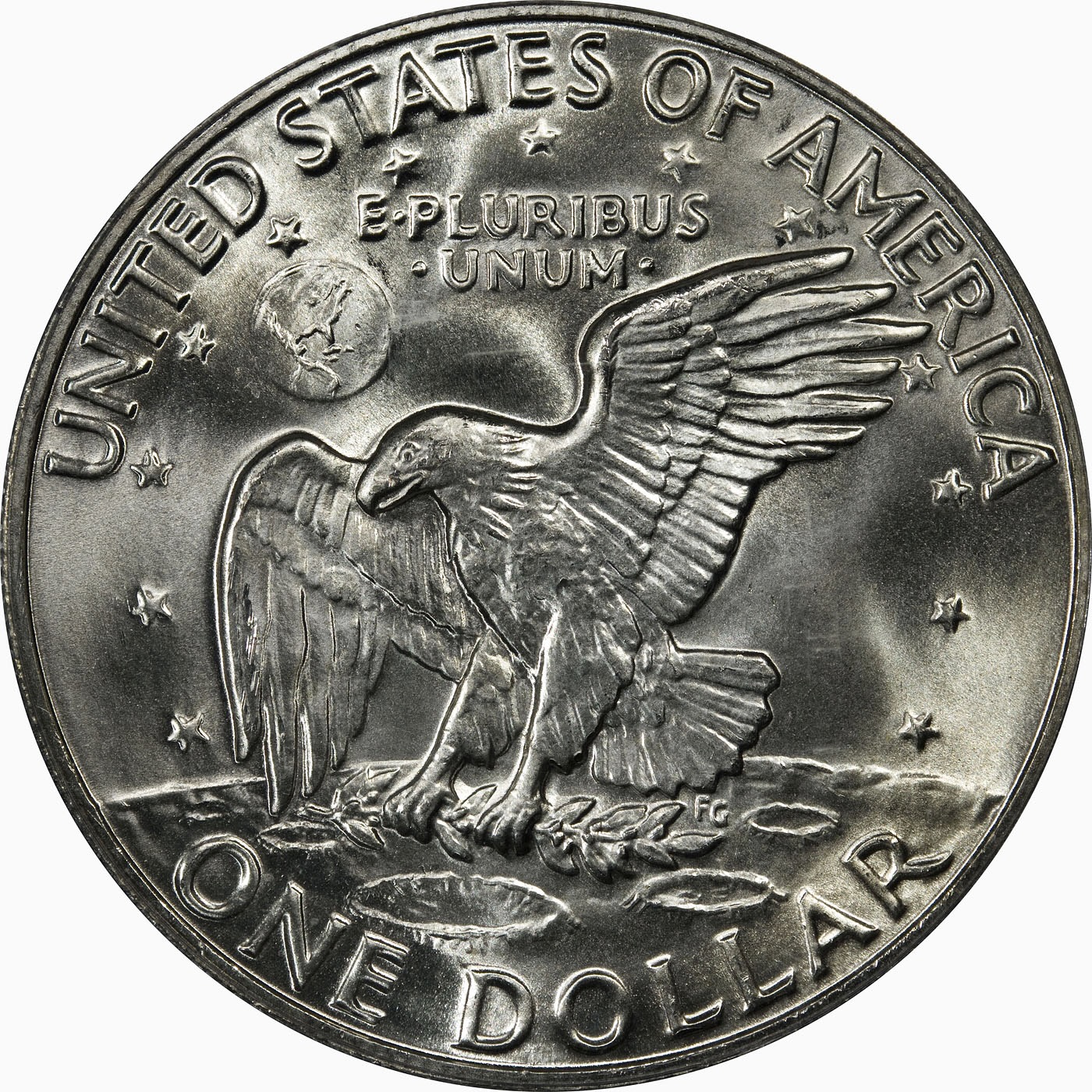
The bald eagle has been incorporated into our coinage from our earliest days, though always on the reverse. When the Eisenhower dollar coin was introduced in 1971, it featured the Apollo 11 mission patch design; for the bicentennial celebration in 1776 the eagle was replaced by a Liberty Bell.
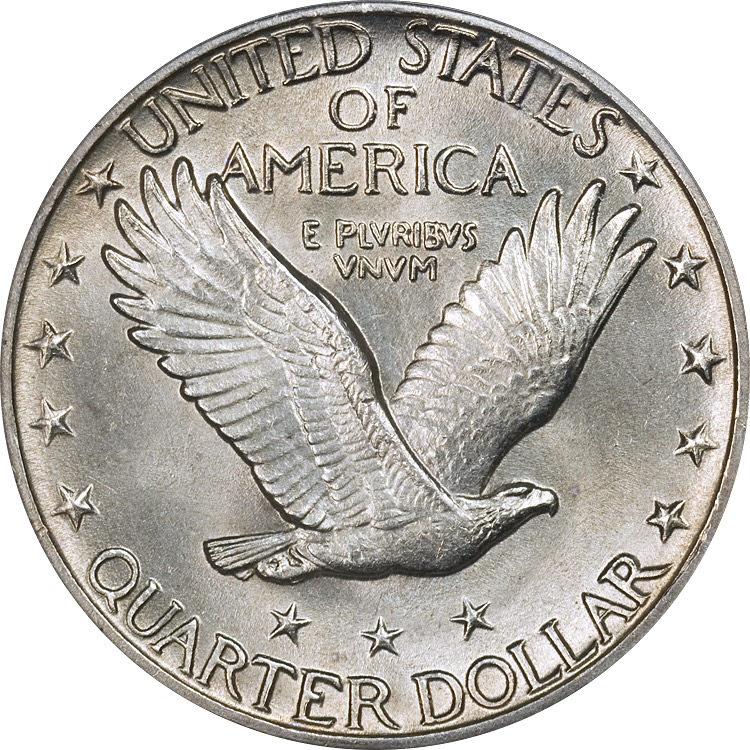
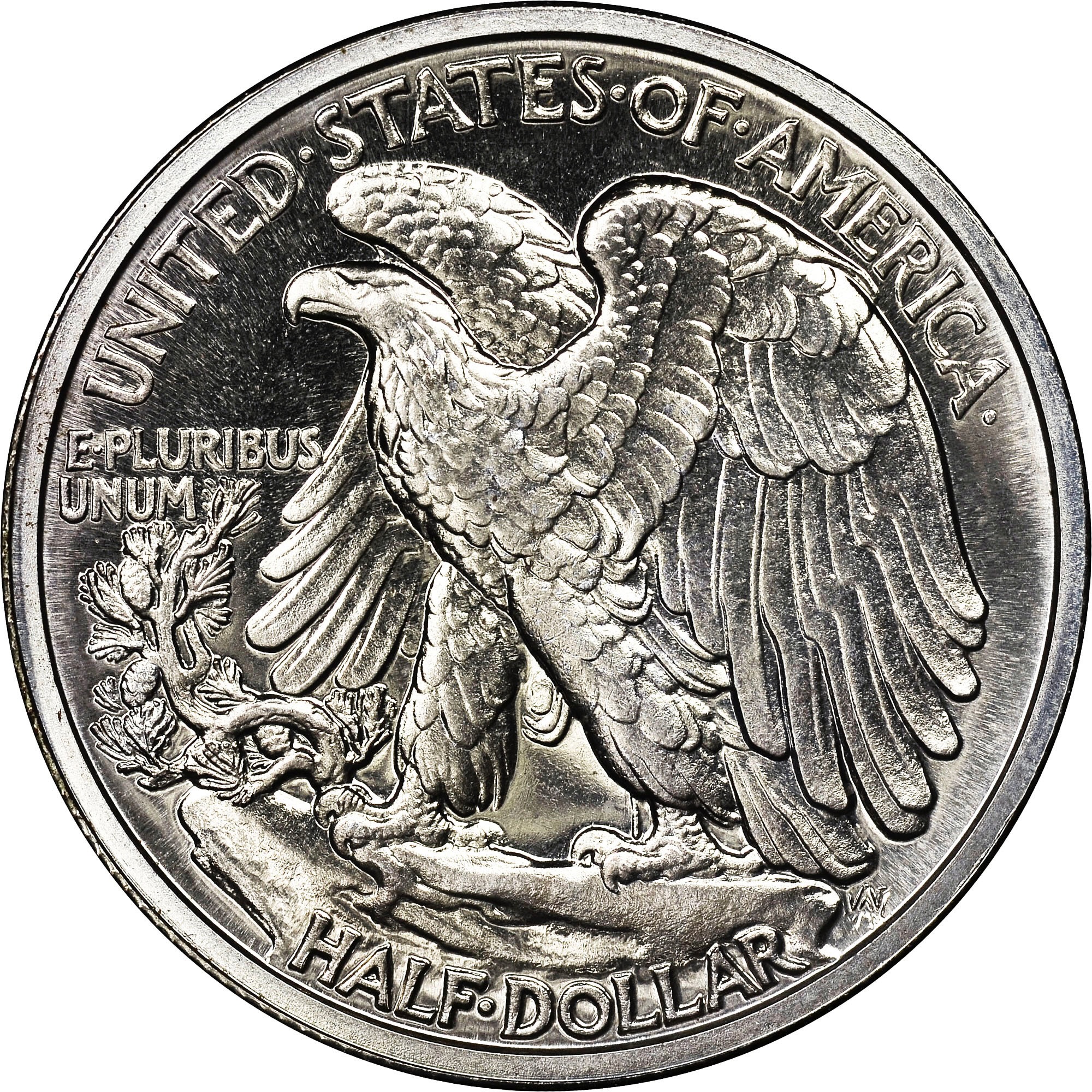
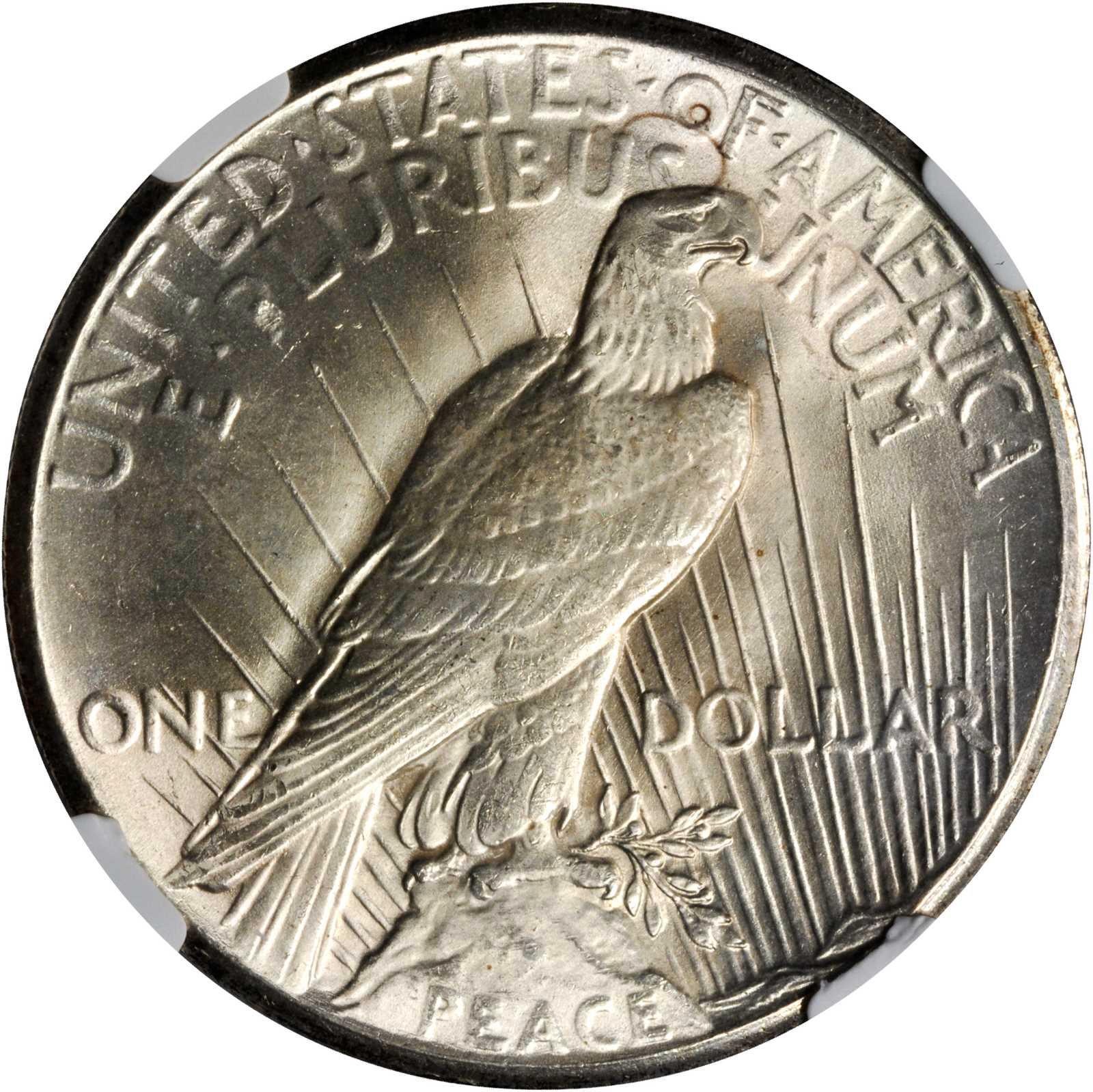
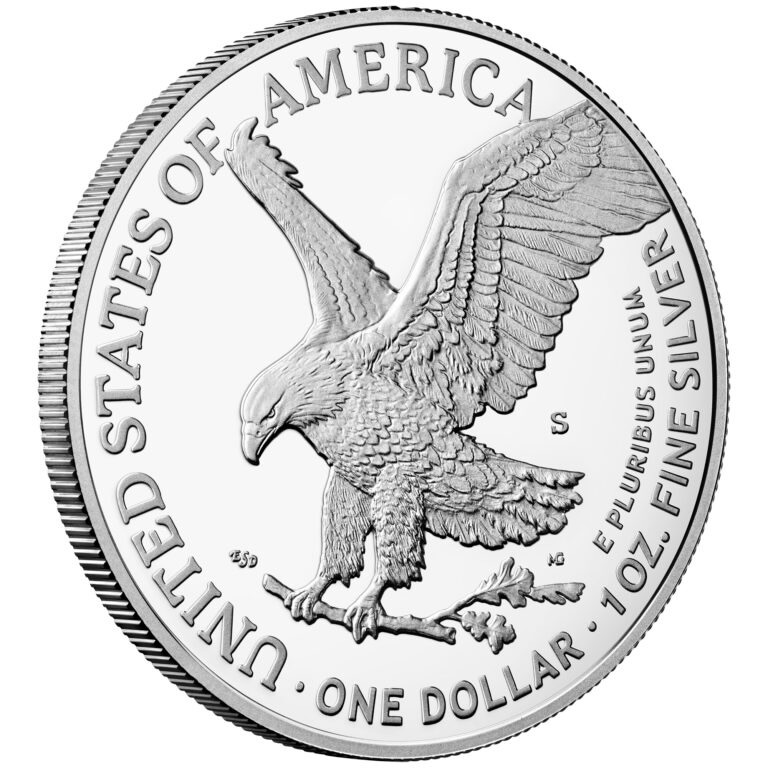
So, what did Neil Armstrong mean when he said, “The Eagle has landed”? Interestingly enough, Eagle was the name of the Lunar Module that landed Armstrong and Aldrin on the moon. They named it after they designed the moon patch with its eagle landing on the moon – an eagle that symbolizes America. So, Armstrong was not only telling Mission Control that he had successfully landed the Eagle but also telling the world that America had reached the moon.
time: 10-20 minutes
Armstrong and Aldrin leave in Eagle, and take it low and lower. They have just enough time and just enough fuel.
Your kids might enjoy coloring some of these pictures of bald eagles, courtesy of supercoloring.com:
After watching the live cam of the Bald Eagle nest in the Natural History activity, our kids added nests to the coloring pages so the eagles had a place to rest.
time: 15 minutes
Onboard Eagle, Aldrin calls out information while Armstrong steers the ship. They fly lower and lower, looking, looking for their landing site.
If you happen to live close enough to a bald eagle habitat you can observe these magnificent creatures soaring and nesting at the right time of the year. For example, there are several bald eagle habitats along the riverbanks of the Potomac River or the James River in Virginia. Take your kid(s) on a field trip to see them in the wild.
If a field trip is not practical, you can also observe bald eagles in the wild via live cams set up by amateur and professional naturalists. This Eagle Cam was set up for a nesting pair along the Dulles Greenway in Virginia. Scroll through the comments to see some of the greatest sequences: the mother laying the eggs, the mother and father arriving, building the nest, incubating the eggs, feeding the eaglet. Best time of the year for viewing is late winter through spring. You can find many other Eagle Cams at the DC Eagle Cam in the National Arboretum, courtesy of the American Eagle Foundation.
Finally, you can also take the kids on a field trip to a bald eagle sanctuary for disabled eagles that are recovering from injuries or can no longer survive in the wild. Your family may be interested in supporting one of the foundations that care for these birds. The American Eagle Foundation is an organization that has been supporting the care and rehabilitation of injured bald eagles for decades.